USAID DEC
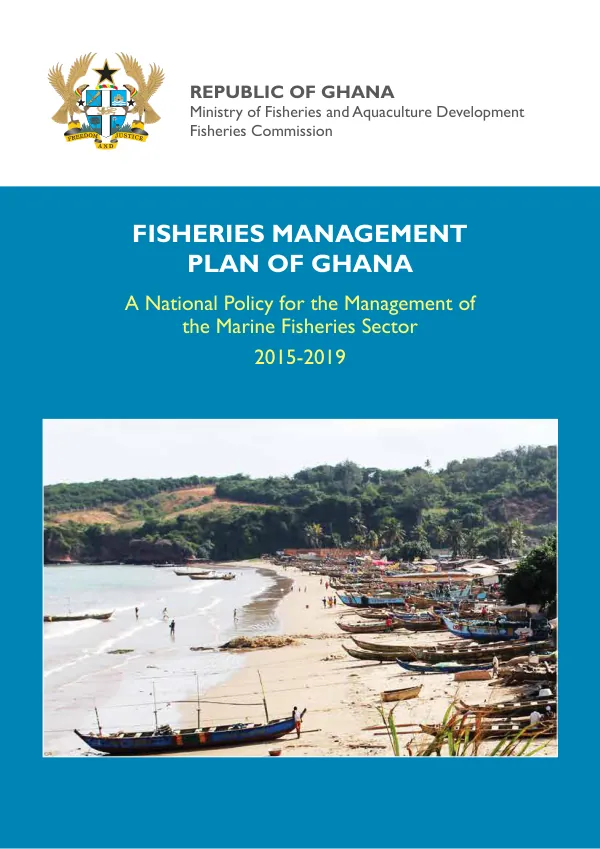
Fisheries Management Plan of Ghana
The fisheries resources of Ghana have long been a significant contributor to the national economy, generating over US$1 billion in revenue each year and accounting for at least 4.5% of Ghana's Gross Domestic Product (GDP).
2015 · 48 pages
Sign in to readA free account is required to download.
Abstract
The sector also provides livelihood for an estimated 10% of the population, representing about 2.5 million people who are employed directly or indirectly, including their dependents. Fish constitutes 60% of the animal protein consumed in Ghana. A gradual decrease in the stocks of fish within Ghana's fisheries waters has been observed due to increasing fishing effort. Weak enforcement and noncompliance with the current fishery management measures have also been identified as contributing factors. To reverse the trend of stock depletion and support socio-economic development and food security for present and future generations of Ghanaians, a national strategic framework is required. The Fisheries Management Plan aims to reduce excessive pressure on fish stocks, ensure that fish stocks are exploited within biologically acceptable levels, and implement fisheries legislation to protect the nation's fish resources. The plan also seeks to protect marine habitats and biodiversity, contribute to enhancing export opportunities and strengthening value addition, and strengthen participatory decision making in fisheries management. The Management Plan applies to capture fisheries in the marine waters of Ghana and covers all fishing vessels fishing in the marine waters of Ghana and Ghanaian flagged vessels wherever they fish. The plan has been developed to meet the following key objectives: reduce excessive pressure on fish stocks, ensure that fish stocks are exploited within biologically acceptable levels, implement effective fisheries legislation, protect marine habitats and biodiversity, contribute to enhancing export opportunities and strengthening value addition, and strengthen participatory decision making in fisheries management. The plan sets out a formal harvest strategy for the fishery and provides direction for the formulation of management actions within the context of the Fisheries Act, 2002 (Act 625), Fisheries (Amendment) Act, 2014 (Act 880), Fisheries Regulations, 2010 (L.I. 1968), and Fisheries (Amendment) Regulations, 2015 (L.I. 2217). The plan is guided by the principles of sustainable fishing and aims to rebuild fish stocks to enhance the socio-economic conditions of fishing communities, create employment, and improve food security. The Management Plan has identified several key issues that need to be addressed, including the industrial trawl fishery, semi-industrial fishery, canoe fishery, and tuna and other large pelagic migratory species. The plan proposes several strategic actions to address these issues, including the implementation of a vessel monitoring system, the establishment of marine protected areas, and the development of a national harvest strategy. The plan also outlines the operational plan for implementing the strategic actions, including the timeline for implementation, the means of implementing the actions, and the mode of enforcement. The plan also provides a financial plan for the first year of implementation, which includes the allocation of resources and the identification of funding sources. Overall, the Fisheries Management Plan of Ghana is a comprehensive plan that aims to reverse the declining trend of fish resources and establish a sound management regime to ensure that fish stocks are exploited sustainably in an enhanced environment. The plan is guided by the principles of sustainable fishing and aims to rebuild fish stocks to enhance the socio-economic conditions of fishing communities, create employment, and improve food security.