USAID DEC
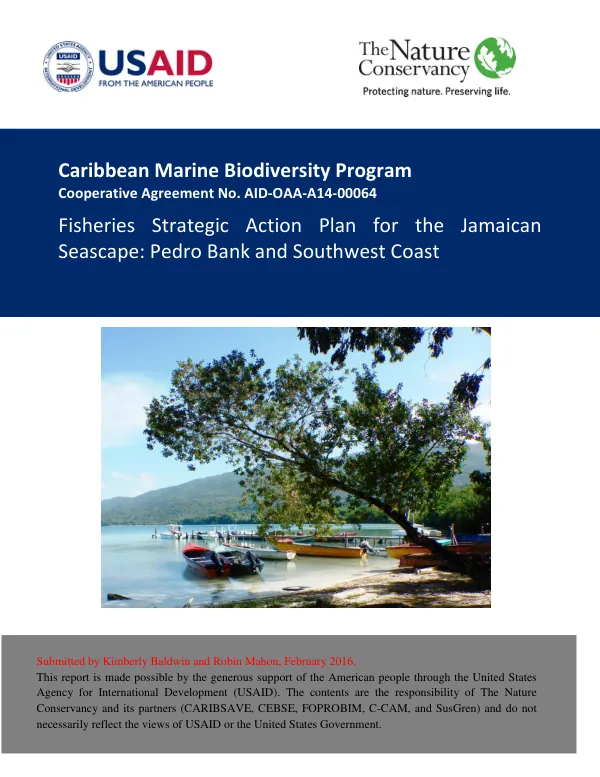
Fisheries Strategic Action Plan for the Jamaican Seascape: Pedro Bank and Southwest Coast
Sign inFOPROBIM
Fisheries Strategic Action Plan for the Jamaican Seascape: Pedro Bank and Southwest Coast
The Caribbean Marine Biodiversity Program (CMBP) is a five-year initiative that aims to reduce threats to marine and coastal biodiversity in priority areas in the Caribbean.
2016 · 66 pages
Sign in to readA free account is required to download.
Abstract
The program targets four high-biodiversity ecosystems, including coral reefs, mangroves, and seagrass beds, and seeks to achieve sustained biodiversity conservation, maintain critical ecosystem services, and improve human wellbeing in communities adjacent to marine protected areas (MPAs). The CMBP is structured around four high-level expected results and involves actions at four geographic scales, including site, seascape, national, and regional levels. The CMBP targets four Caribbean seascapes, with the Pedro Bank and Southwest Coast of Jamaica being one of them. The geographic extent of the Jamaican Seascape includes the Southwest Coast of Jamaica from Belmont in Westmoreland to Great Bay in Treasure Beach, St. Elizabeth, and includes the island shelf off this area as well as the Pedro Bank and Cays to the south. A key step in the CMBP is to develop a Fisheries Sector Action Plan (FSAP) for each seascape, which begins with a Rapid Fisheries Sector Assessment (RFSA) of the small-scale and industrial fisheries found within the Jamaican Seascape. The RFSA provides a comprehensive assessment of the fisheries sector, including the ecosystems that support them, and the social and economic aspects of fishing and postharvest activities. The assessment is conducted using Ecosystem-Based Management (EBM) or Ecosystem Approach to Fisheries (EAF) and provides a basis for strategic planning with the CMBP seascape team and key stakeholders to complete the FSAP for the Jamaican Seascape. The FSAP will recommend and elaborate on a set of practical, feasible, concrete, and customized actions to be carried out in the seascape to promote sustainable fisheries. The FSAP will focus on three general categories of actions: site-based fisheries management and livelihood actions, capacity building and training, and policy reforms and governance. The actions identified for the Jamaican Seascape are developed through an action planning process with key fisheries stakeholders, which includes analysis of Strengths, Weaknesses, Opportunities, and Threats (SWOT), action planning workshops, prioritization of strategies and actions, and development of priority actions. The key actions identified for the Jamaican Seascape include exploring a diversified livelihood approach, capacity building for community-based organizations (CBOs) and fisher folk, promoting sustainable fisheries through public awareness, valuation of fisheries, securing sustainable financing, adaptive framework for fisheries co-management, and promoting sustainable fisheries through training and implementation of a sustainable fisheries program. These actions are designed to promote sustainable fisheries and improve the livelihoods of fisher folk and communities in the Jamaican Seascape. The FSAP for the Jamaican Seascape is developed through a collaborative process with key fisheries stakeholders, including government agencies, CBOs, and fisher folk. The plan is designed to be practical, feasible, and customized to the needs of the Jamaican Seascape and its stakeholders. The plan will be implemented through a series of actions and activities that will promote sustainable fisheries and improve the livelihoods of fisher folk and communities in the Jamaican Seascape. The implementation of the FSAP will involve a range of stakeholders, including government agencies, CBOs, fisher folk, and other organizations. The plan will be implemented through a series of actions and activities, including capacity building and training, policy reforms and governance, and site-based fisheries management and livelihood actions. The plan will also involve the development of an adaptive framework for fisheries co-management, which will enable the Jamaican Seascape to respond to changing environmental and social conditions. The FSAP for the Jamaican Seascape is an important step towards promoting sustainable fisheries and improving the livelihoods of fisher folk and communities in the Jamaican Seascape. The plan is designed to be practical, feasible, and customized to the needs of the Jamaican Seascape and its stakeholders, and will be implemented through a collaborative process with key fisheries stakeholders.