THE WORLD FOOD PROGRAMME
Food for Peace Fact Sheet Nepal
Food insecurity remains high in Nepal following the end of its civil war in 2006.
2009 · 1 pages
Sign in to readA free account is required to download.
Abstract
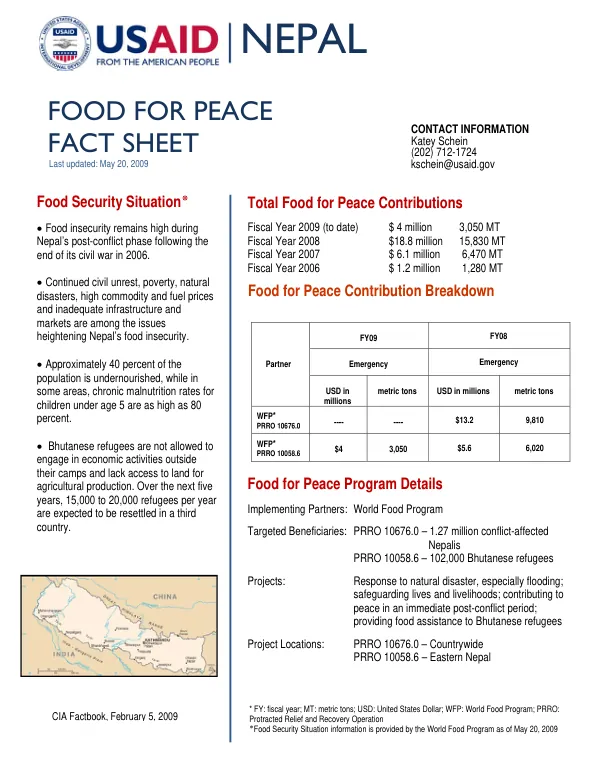
Continued civil unrest, poverty, natural disasters, high commodity and fuel prices, and inadequate infrastructure and markets are among the issues heightening Nepal's food insecurity. Approximately 40 percent of the population is undernourished, while in some areas, chronic malnutrition rates for children under age 5 are as high as 80 percent. Bhutanese refugees are not allowed to engage in economic activities outside their camps and lack access to land for agricultural production. Over the next five years, 15,000 to 20,000 refugees per year are expected to be resettled in a third country. The Food for Peace program in Nepal is implemented by the World Food Program. The program targets 1.27 million conflict-affected Nepalis and 102,000 Bhutanese refugees. The program's objectives include responding to natural disasters, safeguarding lives and livelihoods, contributing to peace in an immediate post-conflict period, and providing food assistance to Bhutanese refugees. The program operates countrywide, with a focus on Eastern Nepal for the Bhutanese refugee population. Food for Peace contributions to Nepal have been significant. In Fiscal Year 2009, the program received $4 million in funding, which provided 3,050 metric tons of food assistance. In Fiscal Year 2008, the program received $18.8 million, which provided 15,830 metric tons of food assistance. In Fiscal Year 2007, the program received $6.1 million, which provided 6,470 metric tons of food assistance. In Fiscal Year 2006, the program received $1.2 million, which provided 1,280 metric tons of food assistance. The World Food Program's Protracted Relief and Recovery Operation (PRRO) 10676.0 has been instrumental in addressing food insecurity in Nepal. This program has provided critical food assistance to 1.27 million conflict-affected Nepalis. The program has also implemented projects to respond to natural disasters, safeguard lives and livelihoods, and contribute to peace in an immediate post-conflict period. The program's success has been evident in the improved food security indicators across the country. The Food for Peace program in Nepal has been a critical component of the country's food security efforts. The program's focus on providing food assistance to conflict-affected populations and Bhutanese refugees has helped to alleviate food insecurity and promote peace and stability in the region. The program's success has been a testament to the importance of international cooperation in addressing global food security challenges.