COUNTER PART INTERNATIONAL
Food for Peace Fact Sheet: Senegal
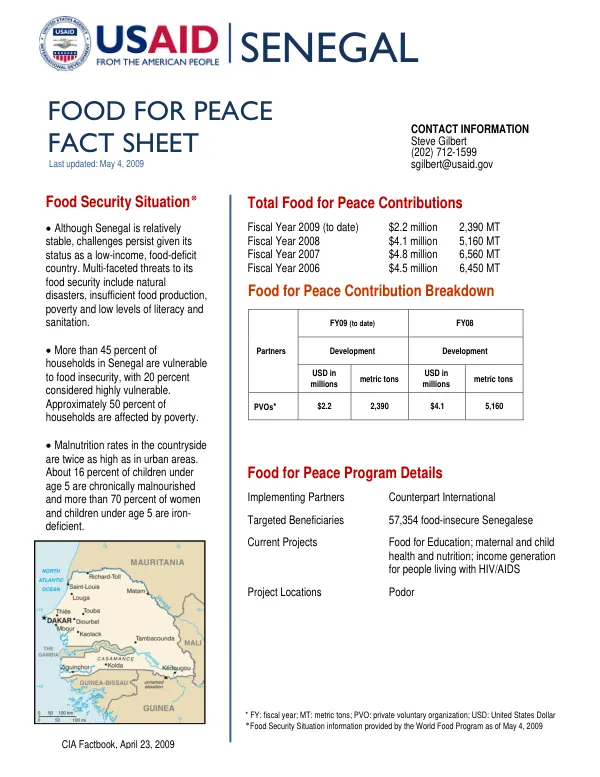
Food for Peace in Senegal began with a contribution of $2.2 million in Fiscal Year 2009, providing 2,390 metric tons of assistance.
2009 · 1 pages
Sign in to readA free account is required to download.
Abstract
This amount is part of a larger effort to address the country's food security challenges. Senegal is classified as a low-income, food-deficit country, facing threats such as natural disasters, insufficient food production, poverty, and low levels of literacy and sanitation. The food security situation in Senegal is precarious, with over 45% of households vulnerable to food insecurity and 20% considered highly vulnerable. Approximately 50% of households are affected by poverty, and malnutrition rates in rural areas are twice as high as in urban areas. Specifically, 16% of children under the age of 5 are chronically malnourished, and more than 70% of women and children under 5 are iron-deficient. The Food for Peace program in Senegal is implemented by Counterpart International, targeting 57,354 food-insecure Senegalese individuals. Current projects focus on food for education, maternal and child health and nutrition, and income generation for people living with HIV/AIDS. These initiatives aim to address the root causes of food insecurity and improve the overall well-being of the targeted population. The program's geographic focus is on the Podor region, where the need for assistance is greatest. The World Food Program has provided information on the food security situation in Senegal, highlighting the urgent need for support. The Food for Peace program is a critical component of the US government's efforts to address global hunger and poverty. In Fiscal Year 2008, the Food for Peace program in Senegal received $4.1 million, providing 5,160 metric tons of assistance. This amount is part of a larger trend of increasing contributions to the program over the years. In Fiscal Year 2007, the program received $4.8 million, and in Fiscal Year 2006, it received $4.5 million. These contributions have helped to address the food security challenges facing Senegal and have improved the lives of thousands of individuals.