CARE
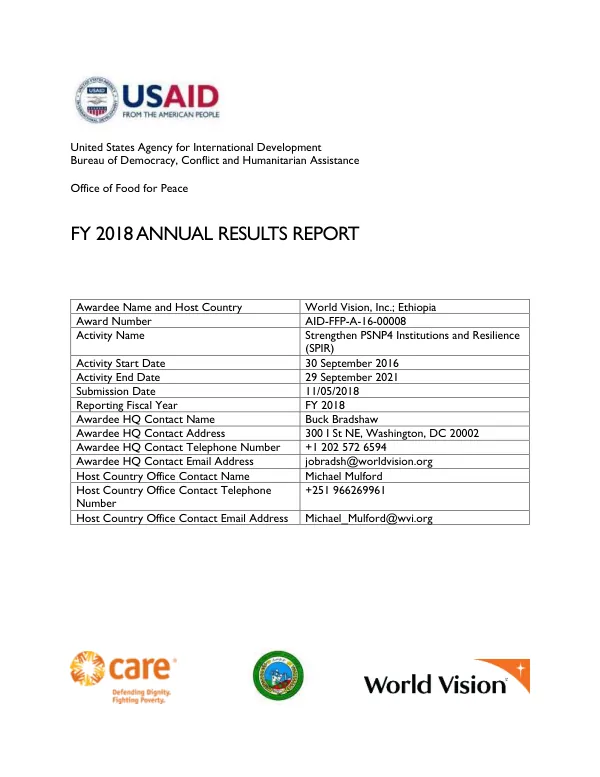
FY 2018 Annual Results Report
The Strengthen PSNP4 Institutional and Resilience (SPIR) program implemented by World Vision and its partners aims to enhance livelihoods, increase resilience against shocks, and improve food security and nutrition for rural households in Ethiopia.
2018 · 36 pages
Sign in to readA free account is required to download.
Abstract
The program targets vulnerable households in the Amhara, Oromia, and Southern Nations, Nationalities, and Peoples regions. The social unrest in the project's implementation area has affected the timely implementation of the project's activities, causing a loss of 1,761 days in the timeline. The program focuses on four main purposes: increasing income, productive assets, and equitable access to nutritious food for vulnerable women, men, and youth; improving nutritional status of children under 2 years of age, pregnant and lactating women, and adolescent girls; increasing women's and youth empowerment and gender equity; and strengthening the ability of women, men, and communities to mitigate, adapt to, and recover from human-caused and natural shocks and stresses. To achieve these purposes, the program has implemented various interventions, including training of trainer (ToT) trainings on animal feeding and forage production for 297 development agents, community facilitators, and Woreda livestock experts, and for 2,648 project participants. The participants received 7.7 MT of forage seed, out of which 1,192 received 6,710 split forage seedlings. The farmers began production of the forage in their backyard, intercropping with other crops that will be ready to feed their livestock in the upcoming 4 months. The program also provided 14,970 Bovan Brown and Sasso breed pullets and 33,685 kg poultry feed on a cost-share basis for 2,495 program participant households. Each participant contributed 360 Ethiopian birr (ETB) as a cost share into their VESA to serve as a rotation lending fund for other members. The pullets have grown and started benefiting those targeted project participants by providing eggs for household consumption and improving household nutrition, as well as helping with income generation. Within this reporting period, out of 13,434 hens that started laying, 523,715 eggs were laid, of which 232,813 (44%) were consumed, and 290,674 were sold. The program has also facilitated a vaccination campaign in project kebeles where the problem was occurring. Compared with the high mortality rate (40–60% according to CSA) in the country, the mortality rate of the distributed pullets was significantly lower, with 1,053 (7%) dying due to a New Castle disease outbreak and predators. The program has earned the participants a total of $30,441 (837,141 ETB) from the sale of eggs. The program has also implemented interventions to improve natural resource management, disaster risk reduction strategies, and the effectiveness and social mobilization of PSNP4 institutions. The program has faced challenges, including the social unrest in the project's implementation area and the government's shutdown of the internet, which has affected the timely implementation of the project's activities. Despite these challenges, the program has made significant progress in achieving its objectives and has contributed to the improvement of food security and nutrition for rural households in Ethiopia.