CARE
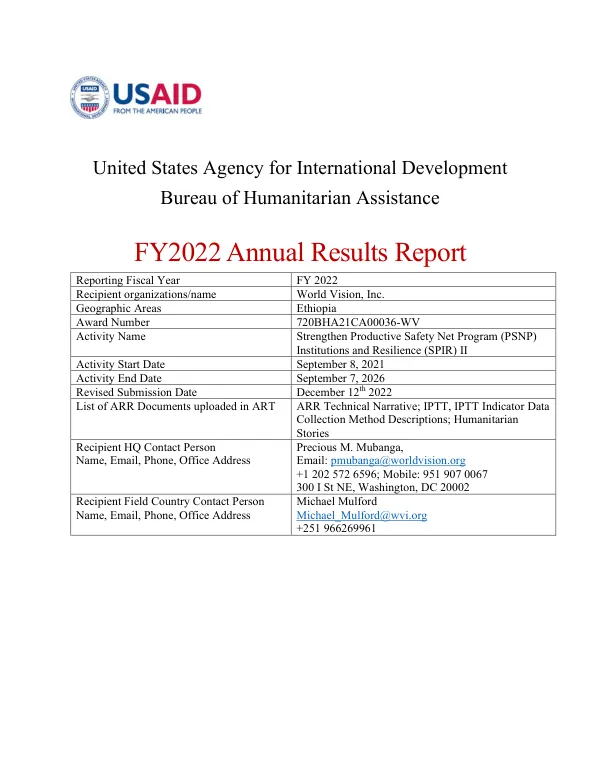
FY 2019 Annual Results Report
Strengthen Productive Safety Net Program (PSNP) Institutions and Resilience (SPIR) II is a five-year Resilience Food Security Activity (RFSA) funded by the United States Agency for International Development (USAID)/Bureau for Humanitarian Assistance (BHA), and implemented by World Vision, CARE, ORDA Ethiopia, and the International Food Policy Research Institute (IFPRI).
29 pages
Sign in to readA free account is required to download.
Abstract
The project is being implemented in nine woredas in Amhara region, and eight woredas in Oromia region. During the reporting period, two significant challenges affected SPIR II operational areas: the conflict in the north and the drought in large parts of Ethiopia. The conflict between the Government of Ethiopia and the Tigray People Liberation Front (TPLF) directly affected all SPIR II operational woredas in Amhara, resulting in the suspension of activities for six months. Post-conflict recovery activities were supported by a USAID/BHA-approved pivot starting in 2022. The security situation remains tenuous, with the TPLF armed forces still occupying one SPIR II woreda, Tsagbji, and parts of Sekota and Gaz Gibla woredas. Regarding drought, the partial and in some places, total failure of the Belg and Meher rains significantly affected the lives and livelihoods of program participants in East and West Hararghe zones. Project participants adopted negative coping strategies. Despite these challenges, SPIR II supported 463,410 (236,339 female) project participants through its diverse interventions. A total of 8,543 Temporary Direct Support (TDS) clients received nutrition counseling, and 2,329 (1,199 female) children under two years were screened during growth monitoring and promotion (GMP) sessions and enrolled in the Community-Led Total Sanitation and Hygiene (CLTSH) program. The project also supported 1,111 (555 female) pregnant and lactating women through the Community Health Facilitators (CHF) program. SPIR II's interventions focused on improving food security, increasing household assets, and enhancing resilience capacities. The project implemented various activities, including farmer training programs, infrastructure development, and market linkage facilitation. The project also supported the development of community assets, including water, sanitation, and hygiene (WASH) facilities, and improved referral and linkages to essential services and institutions. SPIR II's systems for PSNP service delivery improved, and the Government of Ethiopia and community early warning, preparedness, and shock response capacities improved. Lessons learned from the project included the importance of addressing conflict and drought-related challenges, and the need for more effective referral and linkages to essential services and institutions. The project's geographic focus was on nine woredas in Amhara region and eight woredas in Oromia region. The timeframes for the project were from September 8, 2021, to September 7, 2026. The project's recommendations included the need for continued support to address conflict and drought-related challenges, and the importance of strengthening PSNP systems and improving referral and linkages to essential services and institutions.
Related documents