USAID DEC
FY16 Q1 Quarterly Report: ECOUT Program
The ECOUT Program, implemented by Mercy Corps Niger, aims to meet the immediate needs of communities affected by recurrent food crises and build local capacity to adapt and build resilience to future stresses and shocks.
2016 · 13 pages
Sign in to readA free account is required to download.
Abstract
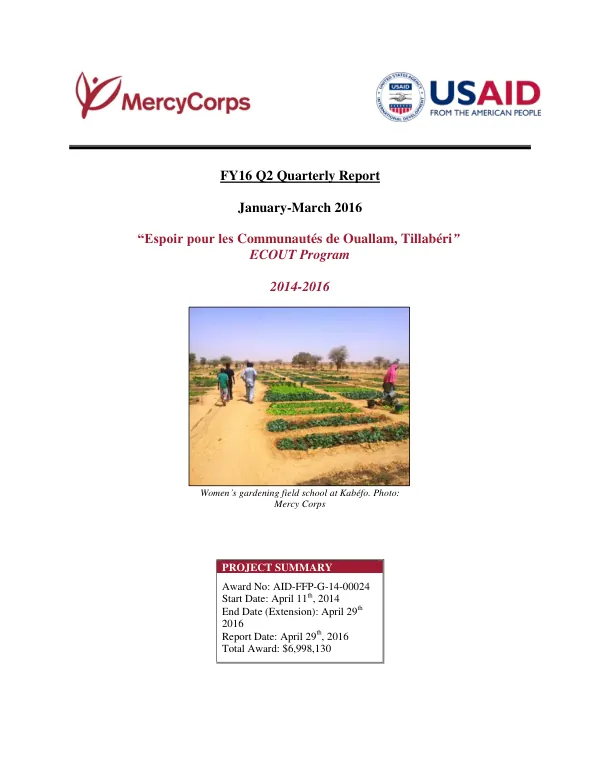
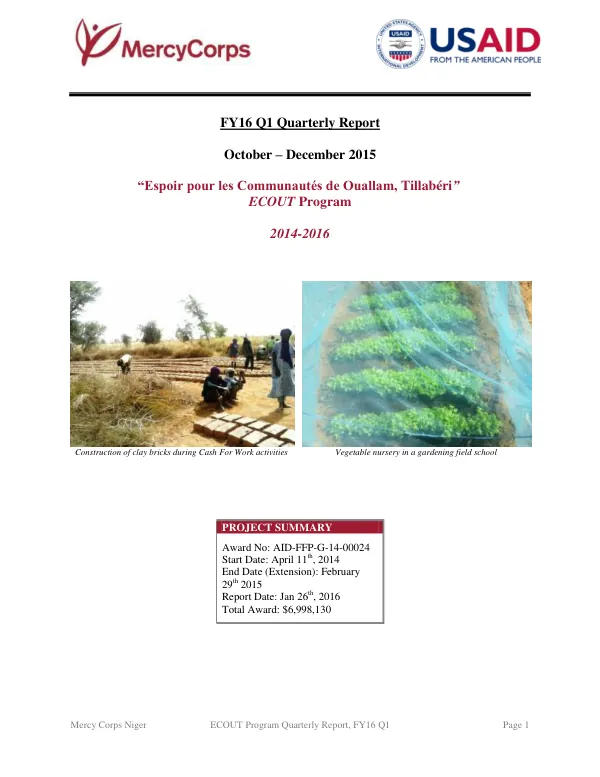
The program targets 56,000 of the most vulnerable individuals in the communes of Ouallam and Dingazi in the Ouallam department. In the first quarter of the No Cost Extension period (October 11, 2015 – February 29, 2016), the main achievements of the program include the implementation of post-harvest Cash For Work activities, which enabled beneficiaries to build 12 new storage facilities for warrantage, create 4,596 garden plots in 16 villages for vegetable production, and contribute to the sanitation of households and public spaces. A total of 7,985 households benefited from Cash For Work activities, receiving XOF 16,500 (US $30) each, totaling XOF 131,752,500 ($239,550). Additionally, 2,585 people, including 1,513 women, 888 men, 109 girls, and 64 boys, benefited from demonstrations of cowpea couscous preparation during 39 village sessions through training of trainers' methodology. Sensitizations on essential nutrition practices, including exclusive breastfeeding, pregnant and lactating women complementary feeding, were held and reached 2,515 people. The program also implemented community-level nutrition messaging and behavior change activities related to essential nutrition actions (ENA) and household dairy consumption. A total of 32 awareness sessions were held, reaching 2,613 people, on the importance of promoting hygiene in a living environment, valuing local food, and prevention of acute respiratory diseases. Furthermore, 16 gardening field schools were established in 16 villages, each receiving a kit of small equipment, improved seeds, and training on conservation agriculture techniques related to vegetable production. The ECOUT program aims to increase the resilience of agro-pastoralist communities to future shocks by supporting community-driven projects to rehabilitate pastureland and increase water efficiency through Food for Work (FFW) activities. The program also contributes to strengthening the GoN's early warning system (EWS) for food insecurity by building the capacity of community-based early warning committees to effectively identify imminent shocks and communicate projected needs to commune-level bodies. Mercy Corps works to ensure that nutrition messaging is a part of all program activities. The program's achievements during the reporting period demonstrate its commitment to addressing the immediate needs of communities affected by food crises and building their resilience to future stresses and shocks. The implementation of post-harvest Cash For Work activities, community-level nutrition messaging, and gardening field schools have contributed to the program's success in improving the nutritional status and resilience of agro-pastoralist communities in the Ouallam department. The ECOUT program's focus on sustainability and preparation for the final program evaluation is evident in its emphasis on building the capacity of community-based early warning committees and ensuring that nutrition messaging is a part of all program activities. The program's achievements during the reporting period demonstrate its commitment to addressing the immediate needs of communities affected by food crises and building their resilience to future stresses and shocks. The program's implementation of post-harvest Cash For Work activities has enabled beneficiaries to build 12 new storage facilities for warrantage, create 4,596 garden plots in 16 villages for vegetable production, and contribute to the sanitation of households and public spaces. The program's focus on community-level nutrition messaging and behavior change activities has reached 2,515 people, including 1,623 men, 1,051 women, 123 boys, and 78 girls, with sensitizations on essential nutrition practices. The program's establishment of 16 gardening field schools in 16 villages has provided beneficiaries with training on conservation agriculture techniques related to vegetable production, including soil manuring, vegetable seedling transplanting, and other techniques. The program's exchange visit between its beneficiaries from Ouallam and those working on the production sites is planned to continue during the next quarter.