MERCY CORPS INTERNATIONAL
MC Niger ECOUT Quarterly Report FY16 Q2
The ECOUT program in Niger began in April 2014 with funding from USAID's Food For Peace initiative.
2016 · 14 pages
Sign in to readA free account is required to download.
Abstract
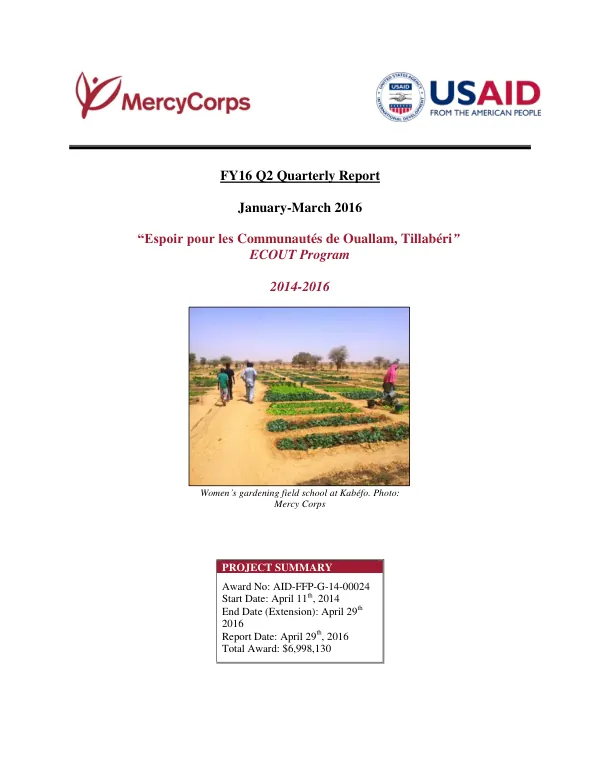
The program aimed to meet the immediate needs of communities affected by recurrent food crises and build local capacity to adapt to and build their resilience to future stresses and shocks. The program targets 56,000 of the most vulnerable individuals (8,000 households) in the two communes of Ouallam and Dingazi in the Ouallam department of Tillabéri region. During the second quarter of 2016, the main achievements of the program include the rehabilitation of 35 hectares of degraded land through cash for work activities. These activities also involved the deepening of ponds, construction of levees to avoid flooding, and realization of hygiene and sanitation activities. A total of 7,986 households benefited from these activities, receiving XOF 12,500 (US $20.3) each, totaling XOF 99,825,000 (US $169,195). The program also organized 13 awareness sessions on essential nutrition actions, reaching 798 people, including 277 men, 474 women, 47 girls, and 37 boys. Additionally, 104 community outreach workers were trained on infant and young child feeding, and they were officially integrated into the network of the Ouallam Health District. Furthermore, the program supported the establishment of gardening field schools in 15 villages, where 1,344 people (90% women) received training from agricultural extension agents on techniques such as creation of nurseries for seedlings, supply of organic manure, and management of vegetables. A total of 45 people from these villages also benefited from an exchange visit to the AINOMA's large-scale vegetable production sites. The program also contributed to the strengthening of early warning systems in Ouallam, with a regional workshop organized to strengthen the system. As a result, 44 secretaries of all the community-based early warning systems were trained on data collection and reporting. The ECOUT program aims to assist 56,000 beneficiaries (8,000 households) over an initial period of 18 months to meet their immediate needs and build their resilience to future shocks and stresses. The program supports agro-pastoralists affected by food insecurity within the communes of Ouallam and Dingazi to improve their nutritional status through the purchase of nutritious food during the lean season using food vouchers and unconditional cash transfers. The program also supports the diversification of household diets by increasing access to dairy products. The program's activities are focused on improving the resilience of agro-pastoralist communities to future shocks. Specifically, the program is supporting community-driven projects to rehabilitate pastureland and increase water efficiency through Food for Work (FFW) activities. The program also contributes to the recovery and increased resilience of farmers in Ouallam department by providing training on climate-smart techniques. Participants who complete the training have earned vouchers to purchase improved agricultural inputs. The program's geographic focus is on the Ouallam department of Tillabéri region in Niger, where 56,000 of the most vulnerable individuals (8,000 households) are targeted. The program's timeframes are from April 2014 to April 2016, with a no-cost extension to slightly more than 24 months in length.