MERCY CORPS INTERNATIONAL
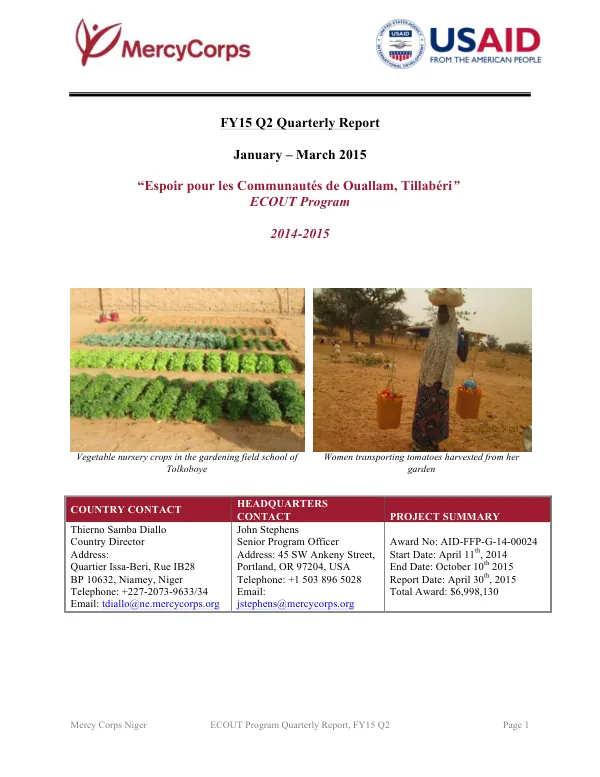
Mercy Corps Niger, ECOUT Program Quarterly Report, FY15 Q1
The ECOUT Program in Niger, implemented by Mercy Corps, aims to assist 56,000 beneficiaries (8,000 households) over a period of 18 months to meet their immediate needs and build their resilience to future shocks and stresses.
2015 · 14 pages
Sign in to readA free account is required to download.
Abstract
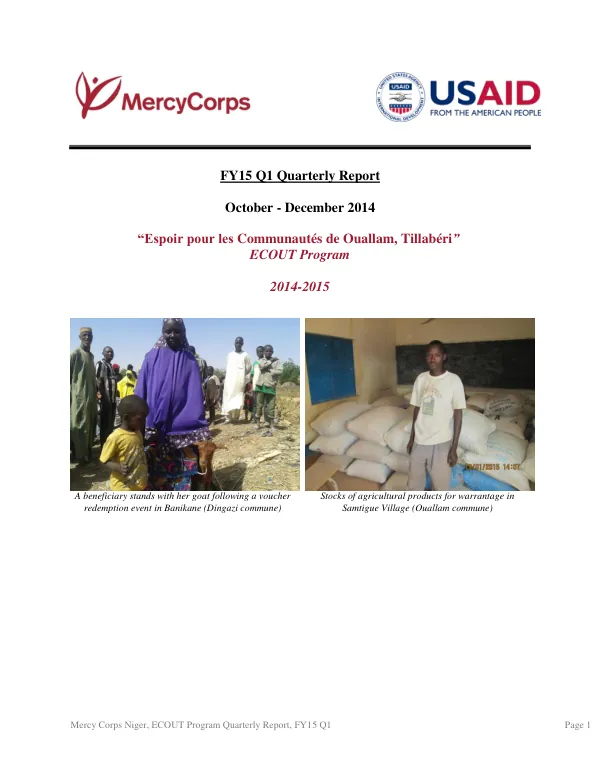
The program focuses on agro-pastoralists affected by food insecurity within the communes of Ouallam and Dingazi to improve their nutritional status through the purchase of nutritious food during the lean season using food vouchers and unconditional cash transfers. Beneficiaries will also receive vouchers for the purchase of a goat, animal feed, and vaccinations, and will benefit from training in animal husbandry, animal health, and fodder management. During the reporting period (October – December 2014), the program completed several activities, including the distribution of unconditional cash transfers to 4,941 households, totaling 160,528,500 XOF (US$ 338,782). Additionally, 4,392 households received vouchers for the purchase of goats, with 554 bucks distributed, and the total value of goats distributed was 153,326,000 XOF (US$ 323,473). Training was conducted with field agents and beneficiaries on the basics of animal health, breeding, milk production, equipment, and infrastructure, and in total, 2,660 beneficiaries have been trained in 24 villages targeted under the program. The program also established a warrantage system in partnership with ASUSU S.A, which will enable farmers to access microcredit using agricultural products as collateral. Stocks of 20,402 kg of agricultural products were created in five pilot villages. Furthermore, 19 community-based early warning systems (CEWS) were established through village assemblies under the chairmanship of the communal authority. Weekly surveys of the five primary markets in Ouallam and Dingazi were conducted to monitor availability, quality, and price of principal consumer products. The ECOUT program aims to increase the resilience of agro-pastoralist communities to future shocks by supporting community-driven projects to rehabilitate pastureland and increase water efficiency through Food for Work (FFW) activities. The program will also contribute to the recovery and increased resilience of farmers in Ouallam department by providing training on climate-smart techniques. Participants who complete the training will earn vouchers to purchase improved agricultural inputs. Additionally, the program will contribute to strengthening the GoN's early warning system (EWS) for food insecurity by building the capacity of community-based early warning committees to effectively identify imminent shocks and communicate projected needs to commune-level bodies. The program's activities have achieved significant results, including the rehabilitation of 1,107 ha of degraded soils through one month of food for work activities, and the distribution of 4,392 goats to 4,392 households. The program has also trained 2,660 beneficiaries in animal husbandry, animal health, fodder management, and nutrition/hygiene around dairy production. Furthermore, 80 outreach workers were trained on malnutrition prevention tools and sensitization techniques, and nutrition caravans traveled to targeted villages to disseminate messages about healthy eating and nutrition practices.
Related documents