INTERNATIONAL ORGANIZATION FOR MIGRATION
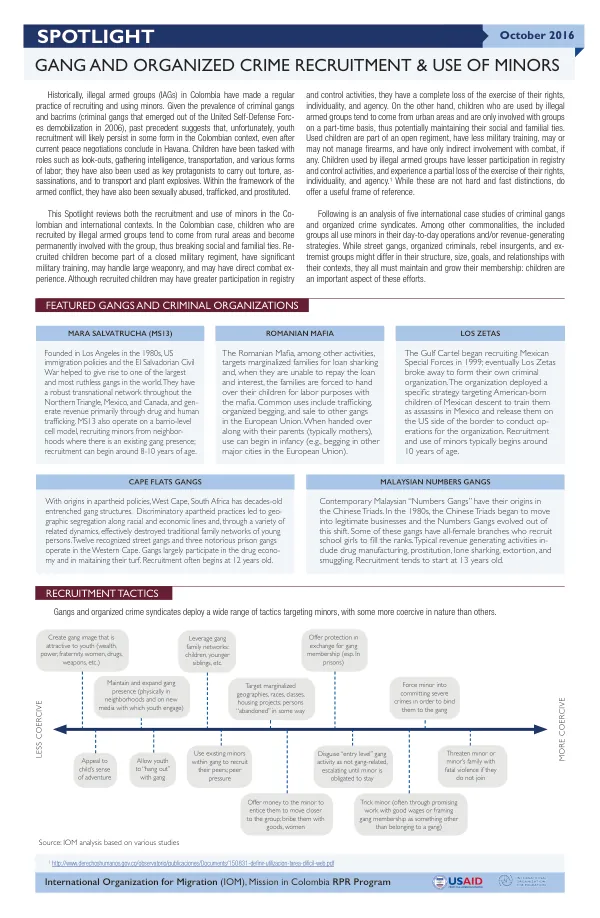
GANG AND ORGANIZED CRIME RECRUITMENT & USE OF MINORS SPOTLIGHT
Historically, illegal armed groups in Colombia have made a regular practice of recruiting and using minors.
2016 · 2 pages
Sign in to readA free account is required to download.
Abstract
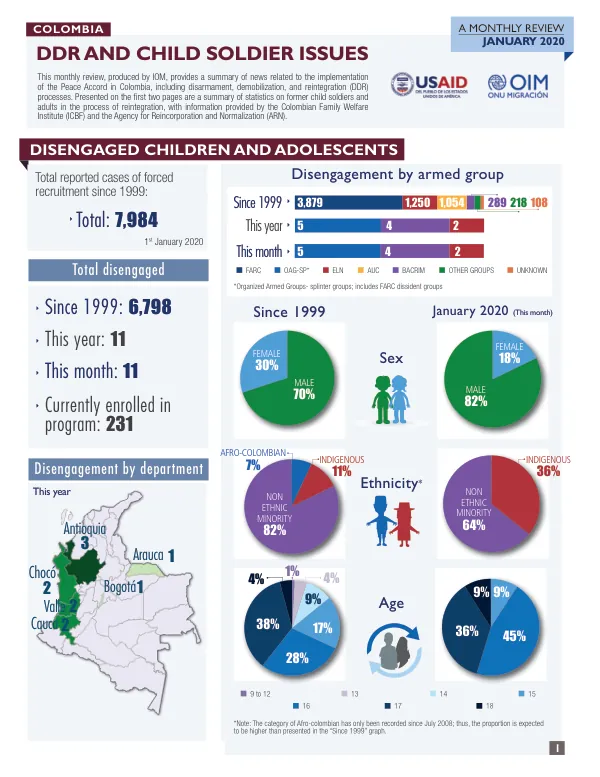
Given the prevalence of criminal gangs and bacrims, past precedent suggests that youth recruitment will likely persist in some form in the Colombian context, even after current peace negotiations conclude. Children have been tasked with roles such as look-outs, gathering intelligence, transportation, and various forms of labor; they have also been used as key protagonists to carry out torture, assassinations, and to transport and plant explosives. Within the framework of the armed conflict, they have also been sexually abused, trafficked, and prostituted. Children who are recruited by illegal armed groups tend to come from rural areas and become permanently involved with the group, thus breaking social and familial ties. Recruited children become part of a closed military regiment, have significant military training, may handle large weaponry, and may have direct combat experience. Although recruited children may have greater participation in registry and control activities, they have a complete loss of the exercise of their rights, individuality, and agency. On the other hand, children who are used by illegal armed groups tend to come from urban areas and are only involved with groups on a part-time basis, thus potentially maintaining their social and familial ties. Used children are part of an open regiment, have less military training, may or may not manage firearms, and have only indirect involvement with combat, if any. The International Organization for Migration (IOM) has analyzed five international case studies of criminal gangs and organized crime syndicates. Among other commonalities, the included groups all use minors in their day-to-day operations and/or revenue-generating strategies. While street gangs, organized criminals, rebel insurgents, and extremist groups might differ in their structure, size, goals, and relationships with their contexts, they all must maintain and grow their membership: children are an important aspect of these efforts. Gangs and organized crime syndicates deploy a wide range of tactics targeting minors, with some more coercive in nature than others. The IOM analysis identified several shared qualities of recruitment and use processes and tactics among gangs and organized crime syndicates. These include creating a gang image that is attractive to youth, appealing to a child's sense of adventure, allowing youth to "hang out" with gang members, using existing minors within the gang to recruit their peers, offering money or goods to entice minors to join, disguising "entry level" gang activity as not gang-related, tricking minors, threatening minors or their families with fatal violence, maintaining and expanding gang presence, leveraging gang family networks, targeting marginalized geographies, races, classes, and housing projects, offering protection in exchange for gang membership, and forcing minors into committing severe crimes to bind them to the gang. Some statistics on the recruitment and use of minors in Colombia are promising. Over the last ten years, reported cases of minor use by illegal armed groups in Colombia have continually declined year over year. However, other sources suggest that the scope of the problem remains substantial. In 2010, UNICEF estimated that between 10,000 and 13,000 children in Colombia were currently participating in armed groups. Another study funded by the Center for Historic Memory in 2012 suggested 18,000 minors belonged to these groups and at least 100,000 more were linked in some way to the illegal economies controlled by them. Certain populations groups are more vulnerable to recruitment and use tactics, with indigenous minors being 674 times more likely to be recruited than non-indigenous minors.