INTERNATIONAL ORGANIZATION FOR MIGRATION
GENDER AND THE IMPLEMENTATION OF THE PEACE ACCORD IN COLOMBIA: PART I
The implementation of the Peace Accord in Colombia began in November 2016, with a focus on addressing the gendered provisions of the agreement.
2018 · 2 pages
Sign in to readA free account is required to download.
Abstract
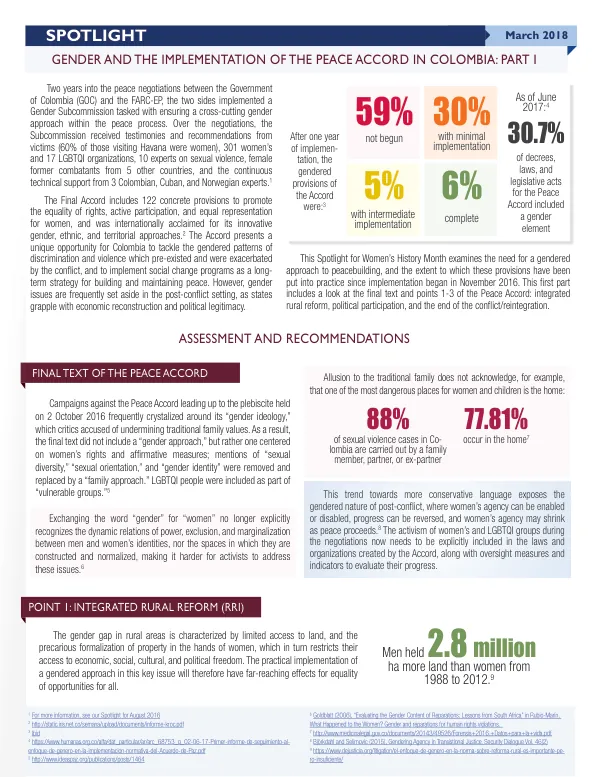
The Final Accord includes 122 concrete provisions to promote the equality of rights, active participation, and equal representation for women. The Accord presents a unique opportunity for Colombia to tackle the gendered patterns of discrimination and violence that pre-existed and were exacerbated by the conflict. The gender gap in rural areas is characterized by limited access to land, with men holding 2.8 million hectares more land than women from 1988 to 2012. The practical implementation of a gendered approach in this key issue will have far-reaching effects for equality of opportunities for all. The Rural Women's Office should be strengthened and articulated with other agencies to guarantee access to housing, financial services, and startup capital for women. In 2016, Colombia placed 66 out of 144 countries in women's political empowerment, despite a progressive legal framework for equality of rights and opportunities. If women do not play a key role in the implementation of peace accords, subsequent laws are likely to be "gender-neutral," re-entrenching regressive gender norms. The National Land Agency (ANT) should consider gender gaps when formalizing and promoting access to land and productive and economic projects. The Final Accord commits to ensuring that former FARC combatants, including women, have access to new citizenships and legality, and can pursue their differential economic, social, and political needs. The task now is to create a measurable reality in which women become the agents of their own reintegration. The Special Organization for Gender established within the Commission to Oversee, Promote, and Verify Implementation of the Peace Accord (CSIVI) has been established, and affirmative actions in selection processes have had positive effects. However, challenges remain, including the lack of representation of black, palenquera, raizal, and Afro-Colombian women, and the absence or under-equipping of daycare centers, which limits women's inclusion in training and reintegration activities. The risk of sexual violence in the Territorial Training and Reincorporation Spaces (ETCR) due to inappropriate relationships between members of the Armed Forces and surrounding communities is also a concern. To address these challenges, an integrated gender approach should be implemented, considering former combatants and recipient communities, and security guarantees should have differential measures for women.