INTERNATIONAL ORGANIZATION FOR MIGRATION
Restorative Practices and Justice: A New Paradigm for Post-Conflict in Colombia
Restorative practices and justice are a new paradigm that has entered the discussion on modern legal systems over the last 20 years, counterpoint to the retributive paradigm.
2018 · 2 pages
Sign in to readA free account is required to download.
Abstract
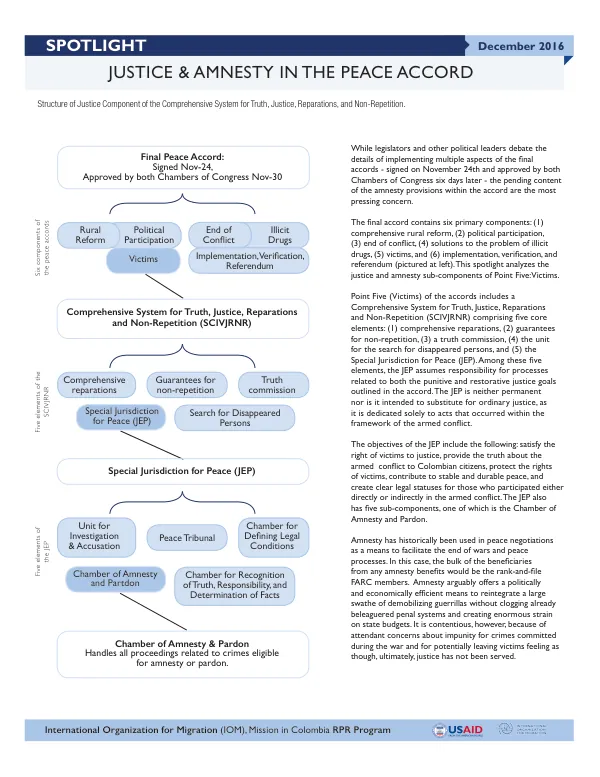
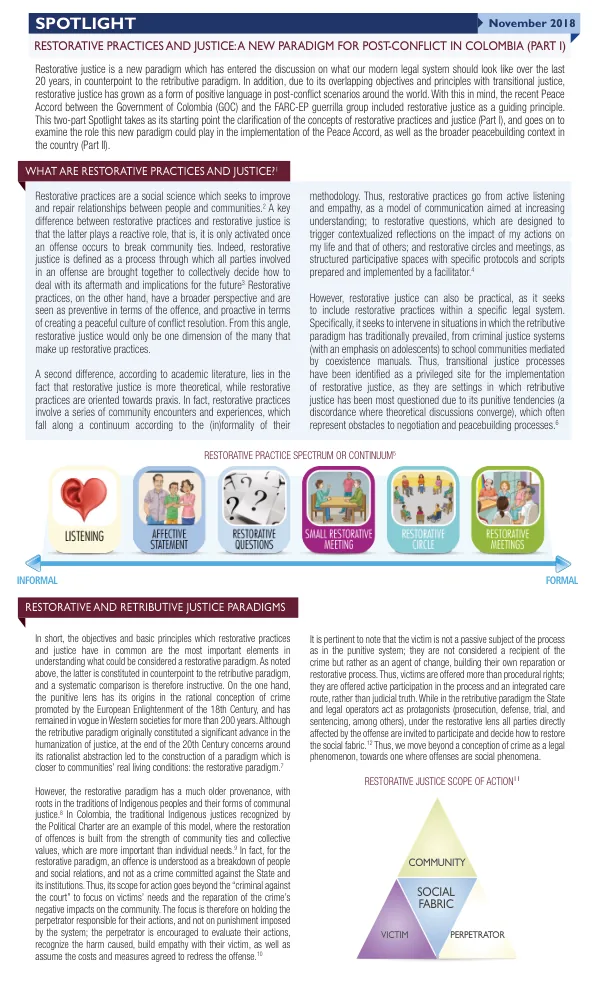
This paradigm has grown as a form of positive language in post-conflict scenarios around the world, particularly in transitional justice processes. The recent Peace Accord between the Government of Colombia and the FARC-EP guerrilla group included restorative justice as a guiding principle. The objectives and basic principles of restorative practices and justice are key elements in understanding the restorative paradigm. This paradigm is constituted in counterpoint to the retributive paradigm, which has its origins in the rational conception of crime promoted by the European Enlightenment of the 18th Century. The retributive paradigm has remained in vogue in Western societies for more than 200 years, although concerns around its rationalist abstraction led to the construction of a paradigm closer to communities' real living conditions: the restorative paradigm. The restorative paradigm has a much older provenance, with roots in the traditions of Indigenous peoples and their forms of communal justice. In Colombia, the traditional Indigenous justices recognized by the Political Charter are an example of this model, where the restoration of offenses is built from the strength of community ties and collective values. For the restorative paradigm, an offense is understood as a breakdown of people and social relations, and not as a crime committed against the State and its institutions. Restorative practices are a social science that seeks to improve and repair relationships between people and communities. A key difference between restorative practices and restorative justice is that the latter plays a reactive role, while the former is preventive and proactive in terms of creating a peaceful culture of conflict resolution. Restorative practices involve a series of community encounters and experiences, which fall along a continuum according to the (in)formality of their methodology. The aim of restorative justice is pedagogical and not punitive, seeking to reintegrate the offender back into the community through non-custodial sanctions. The real objective is to offer new life projects beyond recognized routes to criminality, promoting reflection on who, how, and why the harm was done. The hypothesis indicates that, if positive opportunities for change are offered, human beings are more cooperative, productive, and happy. The restorative justice paradigm's objectives can be summarized in three interrelated aspects: the offender's responsibility, their reintegration into the community, and the restoration of the social fabric through the reparation of the offense against the victim and the affected community nucleus. Different contexts play a fundamental role in the restorative process, and the ideal is to draw on cultural traditions and roots. The aim is to capitalize on social conflict by promoting the ethical development of the community through a joint response to harm. The disjuncture between the retributive and restorative paradigms reminds us of a fundamental consideration: how justice is conceived defines the behavior, decisions, and process of dealing with conflicts in society. Just as our societies have changed significantly over the past 200 years, the justice model's institutions and values must adapt to these changes. The restorative paradigm offers a new approach to justice, one that prioritizes the restoration of relationships and the reintegration of offenders into their communities.
Related documents