USAID DEC
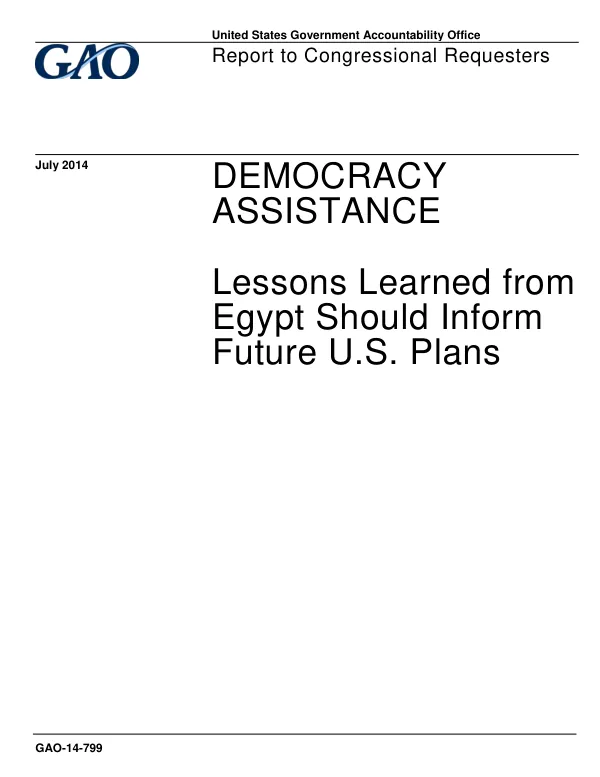
GAO-14-793T, DEMOCRACY ASSISTANCE: Lessons Learned from Egypt Should Inform Future U.S. Plans
Sign inTHE INTERNATIONAL REPUBLICAN INSTITUTE
GAO-14-793T, DEMOCRACY ASSISTANCE: Lessons Learned from Egypt Should Inform Future U.S. Plans
The U.S.
2014 · 9 pages
Sign in to readA free account is required to download.
Abstract
government has provided democracy and governance assistance to Egypt for over 10 years, with funding totaling approximately $140 million from fiscal year 2009 to March 31, 2014. The principal U.S. agencies engaged in these efforts, the Department of State and the U.S. Agency for International Development, have funded a variety of activities, including political party strengthening, election monitoring, and independent media development, to be implemented by U.S. and Egyptian organizations. The U.S. government increased the amount of funding it awarded in Egypt for democracy and governance assistance from approximately $13 million in fiscal year 2010 to approximately $72 million in fiscal year 2011. The Egyptian government objected to the United States providing direct funding to nongovernmental organizations (NGOs), citing concerns that USAID was violating the terms of a process outlined in 2004. In response, U.S. government officials stated that they were interpreting their commitments based on the conditions applied by the Brownback Amendment, which requires that organizations implementing democracy and governance activities in Egypt not be subject to prior approval of the Egyptian government. Despite this, the Egyptian government raided the offices of four U.S.-based NGOs in December 2011, charging them with establishing and operating unauthorized international organizations. The Egyptian government convicted a total of 43 employees from the four U.S. organizations and a German organization, the Konrad Adenauer Foundation, in June 2013, and the NGOs were forced to close their operations in Egypt. The U.S. government provided diplomatic, legal, financial, and grant flexibility support to the four prosecuted U.S. NGOs, including holding meetings with Egyptian officials, working with the NGOs' lawyers to develop legal strategies, and approving grant modifications to allow the organizations to modify their programming. The U.S. government's democracy and governance assistance in Egypt has been affected by the prosecution of NGO workers, with the Egyptian government's actions leading to a significant increase in the risks associated with providing assistance to unregistered NGOs. The U.S. government has not documented lessons learned from the U.S. experience in Egypt and has not incorporated these lessons into their risk management plans for future democracy and governance assistance. The U.S. government's failure to document and incorporate lessons learned from the U.S. experience in Egypt may hinder their ability to effectively manage risks and improve the effectiveness of their democracy and governance assistance programs. The U.S. government's democracy and governance assistance in Egypt has been focused on supporting the development of a more democratic and stable Egypt, with a focus on strengthening civil society, promoting good governance, and supporting the rule of law. The U.S. government has provided funding for a range of activities, including political party strengthening, election monitoring, and independent media development, in an effort to promote democratic values and practices in Egypt. However, the Egyptian government's prosecution of NGO workers has created significant challenges for the U.S. government's democracy and governance assistance efforts in Egypt, highlighting the need for the U.S. government to develop more effective risk management strategies and to incorporate lessons learned from the U.S. experience in Egypt into their future plans for democracy and governance assistance.