USAID DEC
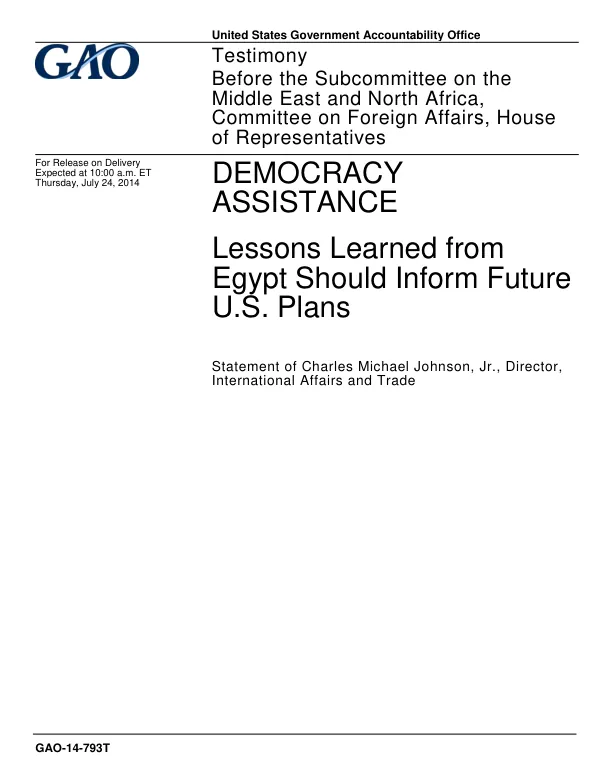
GAO-14-799, DEMOCRACY ASSISTANCE: Lessons Learned from Egypt Should Inform Future U.S. Plans
Sign inTHE INTERNATIONAL REPUBLICAN INSTITUTE
GAO-14-799, DEMOCRACY ASSISTANCE: Lessons Learned from Egypt Should Inform Future U.S. Plans
Egypt has been a key strategic partner of the United States for over 30 years, receiving billions of dollars in U.S.
2014 · 42 pages
Sign in to readA free account is required to download.
Abstract
assistance. The country has undergone a series of political transitions since the January 2011 revolution, which ended the nearly 30-year presidency of Hosni Mubarak. The U.S. government has funded democracy and governance activities in Egypt for more than 10 years, increasing its funding after the 2011 revolution. The U.S. government awarded approximately $13 million in fiscal year 2010 and approximately $72 million in fiscal year 2011 for democracy and governance assistance in Egypt. In total, the U.S. government has awarded approximately $140 million for democracy and governance assistance in Egypt from fiscal year 2009 to March 31, 2014. The Department of State and the U.S. Agency for International Development used this money to fund a variety of activities, including political party strengthening, election monitoring, and independent media development, to be implemented by a range of U.S. and Egyptian organizations. In December 2011, the Egyptian government raided the offices of four U.S.-based nongovernmental organizations (NGO) that were implementing U.S.-funded democracy and governance activities. The Egyptian government charged employees of these four organizations, including Freedom House, the International Center for Journalists, the International Republican Institute, and the National Democratic Institute, with establishing and operating unauthorized international organizations. The U.S. government identified potential risks in providing democracy and governance assistance in Egypt, including the Egyptian government's likely objection to the U.S. plan to use $65 million to directly fund NGOs in 2011. The Egyptian government had repeatedly raised objections to such direct funding since the U.S. Agency for International Development began it in 2005. The U.S. government provided the four prosecuted U.S. NGOs with diplomatic, legal, financial, and grant flexibility support. The U.S. government's diplomatic efforts included holding multiple meetings with Egyptian officials to try to defend the NGO employees. U.S. legal support to the NGOs included working with the NGOs' lawyers to develop legal strategies for the case. The Egyptian government's trial of the four U.S. NGOs significantly affected U.S. democracy and governance assistance in Egypt. The four prosecuted U.S. NGOs are no longer conducting activities inside Egypt and modified or stopped a number of their programs. Other NGOs implementing U.S. democracy and governance programs reported experiencing delays in obtaining Egyptian government approval to receive U.S. funds. Since the start of the trial, in 2012, the amount of funding and number of grants awarded for democracy and governance projects in Egypt decreased, and some activities are now more challenging for the U.S. government to implement. The U.S. government has taken some steps to manage the risks of providing democracy and governance assistance in Egypt, including the issuance of an April 2013 cable that provided guidance on how to counter increasing risks to NGOs globally. However, the U.S. government has not documented lessons learned from the U.S. experience in Egypt or used these lessons to inform their risk management plans for future democracy and governance assistance. The U.S. government recommends that State and USAID incorporate lessons learned from their experience in Egypt into risk management plans for future democracy and governance assistance efforts. State and USAID concurred with the recommendation.