USAID
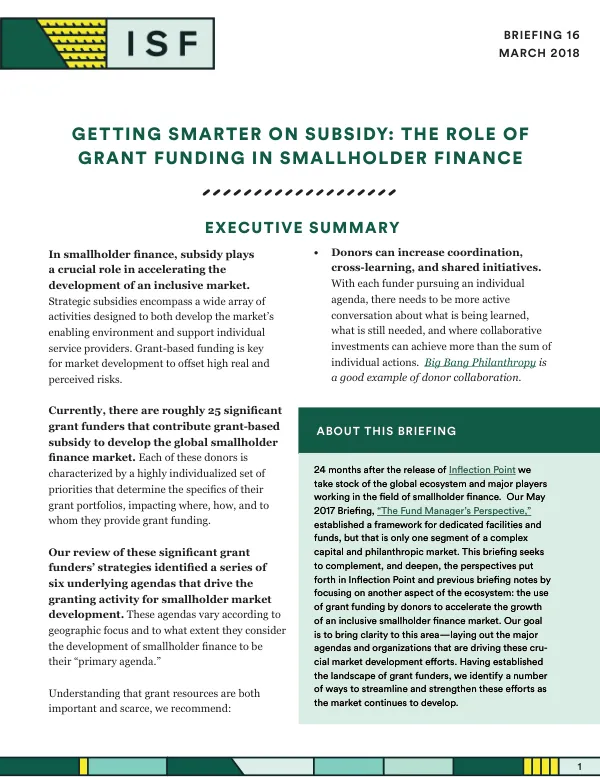
Getting Smarter on Subsidy: The Role of Grant Funding in Smallholder Finance
Smallholder finance market development has evolved significantly over the past five years, with an estimated over $50 billion in smallholder finance being deployed through various financial institutions and value chain actors in Sub-Saharan Africa, Latin America, and Southeast Asia.
2018 · 15 pages
Sign in to readA free account is required to download.
Abstract
Strategic use of subsidy is crucial to offset the high real and perceived risks associated with private sector involvement in this market. This experience mirrors the early periods of Grated credit markets in developed countries, where public entities played a key role in providing concessional funding and public goods such as research, regulatory frameworks, and other services that enhanced the sector overall. The ongoing role of subsidy in smallholder finance market development is critical, as grant cycles and strategies provide market clarity from donors. Donors can further support market development by actively linking short-term catalytic subsidy to long-term subsidy and investment. Grants are essential to catalyze market development, but will not be sufficient to meet the long-term subsidy needs of the market. To address this, donors need to proactively plan and facilitate grantees' access to other sources of private capital and long-term government subsidies. The current challenge is to ensure that subsidies accelerate the development of an inclusive smallholder finance market. In developing economies, which are evolving constantly and dramatically, there is an additional imperative of ensuring small producers have access to financial services as agricultural markets mature and restructure. Meeting this challenge requires deploying what is referred to as "smart subsidy." Subsidy is a key component in enabling the provision of financial services to smallholder farmers and agri-SMEs. There are two main approaches to subsidy: Pre-Competitive Market Development activities and Advancing High-Potential Models. Pre-Competitive Market Development activities are grant-funded and benefit all or many market participants. This includes support for a variety of public-good services, such as knowledge development, supporting partnerships, and priming markets for investment. These efforts aim to create a strong enabling environment and marketplace, with smallholder consumers, investors, and financial service providers that can productively engage in the market. Advancing High-Potential Models is accomplished by supporting individual financial service providers and lenders through grants and concessional capital. Grants are deployed to nurture innovative models, often in the form of operational support to offset scaling costs. Concessional capital is deployed to kick-start investment activities and catalyze additional investment flows. These two approaches are complementary and both are required for the holistic development of the smallholder finance market. The concept of "smart subsidy" was introduced in Inflection Point, and it emphasizes the strategic use of donor funds and public investments. Achieving "smart subsidy requires a strong understanding of ongoing efforts across geographies, organizations, and organizations. The goal is to create an enabling environment that allows smallholder finance to quickly and inclusively scale.
Related documents