USAID DEC
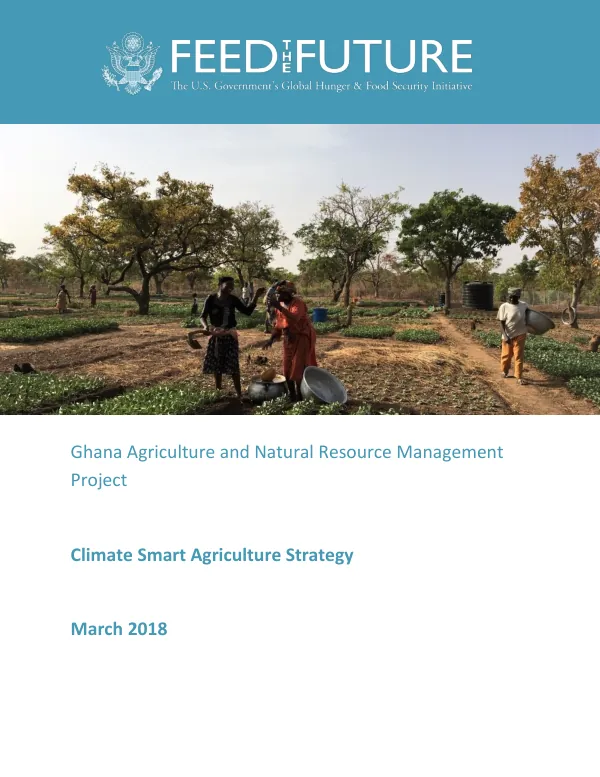
Ghana Agriculture and Natural Resource Management Project Climate Smart Agriculture Strategy
Sign inWINROCK INTERNATIONAL FOUNDATION
Ghana Agriculture and Natural Resource Management Project Climate Smart Agriculture Strategy
The Ghana Agriculture and Natural Resource Management Project Climate Smart Agriculture Strategy aims to provide guidance and a framework for addressing climate-smart agriculture (CSA) within the project's parameters.
2018 · 27 pages
Sign in to readA free account is required to download.
Abstract
The strategy identifies action areas and intervention domains closely aligned with Government of Ghana and USAID priorities, occurring at the field, community, landscape, and institutional levels. These activities consider the economic, technical, and governance dimensions of CSA, including constraints to scale-up and guidance on appropriate approaches and communication methods. Priority interventions on a technical level include moringa cultivation, zai pit techniques, bunds and other soil and water conservation techniques, dry season gardening, farmer-managed natural regeneration (FMNR) and agroforestry, composting/mulching, minimum tillage and no-till, organic matter/manure/organic fertilizer, improved seed, new crops/varieties, crop rotation and cover crops, and fire control. On a governance level, priority CSA interventions require reinforcing land tenure and capacity building for collective action to overcome economic constraints. The strategy emphasizes the importance of creating a shared vision of CSA under the project, determining areas of increased attention and coordination, developing implementation plans for key intervention areas, integrating CSA into the work planning process, and adhering to reporting and monitoring requirements. The strategy also highlights the need for effective approaches and communication for CSA, including addressing push, pull, and rules of the game constraints. The Ghana Agriculture and Natural Resource Management Project is a five-year, $24,900,000 program implemented by Winrock International, in partnership with Nature Conservation Research Centre and the Center for Conflict Transformation and Peace Studies. The project supports USAID's Development Objective 2 and the Ghana Feed the Future Multi-Year Strategy, aiming to achieve poverty reduction through sustainable increases in wealth and improved nutrition from natural and non-traditional agriculture products. Climate Smart Agriculture is defined as an approach to developing technical, policy, and investment conditions to achieve sustainable agricultural development for food security under climate change. According to the FAO, CSA is "Agriculture that sustainably increases productivity, resilience (adaptation), reduces/removes Greenhouse Gases (GHGs) (mitigation), and enhances achievement of national food security and development goals." The strategy particularly focuses on Outcome 2: Improved Food and Nutritional Security as the main focus of agricultural-related technical interventions. The adoption of CSA approaches and practices by smallholder farmers has been slow, piecemeal, and largely unsustained, despite its focus as a key development goal. However, there are positive examples of progress, especially in conservation agriculture and some economic tools to mitigate climate change risk. The strategy aims to facilitate integration and synergy across outcomes and relevant components of the project, taking advantage of the entire project's work on the technical, economic, and governance aspects of rural development that are essential for scaling up.