USAID DEC
Shea Kernel Roasting Improvement Project – Problem Definition and Opportunity Scoping
Sign inWINROCK INTERNATIONAL FOUNDATION
Shea Kernel Roasting Improvement Project – Problem Definition and Opportunity Scoping
Shea kernel roasting is a critical step in the production of shea butter, a valuable commodity in West Africa.
2018 · 22 pages
Sign in to readA free account is required to download.
Abstract
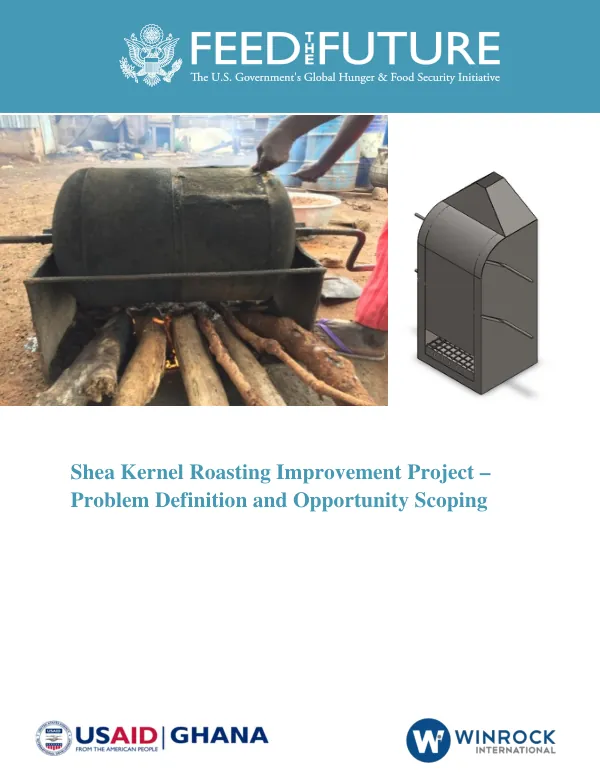
The current process used by smallholders, primarily women, involves hand-crafted butter processors roasting shea kernels in cylindrical drums over an open fire. This method is plagued by low thermal efficiency, high fuel consumption, inconsistent roasting quality, and high particulate emissions. The roasting process is a labor-intensive and time-consuming step, taking approximately two days to complete the production process. The steps involved in transforming shea nuts to oil include collecting and processing the shea fruit, par-boiling the nuts, washing, drying, and sorting the kernels, crushing the kernels with bats or sticks, roasting the kernels in cylindrical drums, grinding the roasted kernels into a finer powder, kneading the ground kernels into a paste, and boiling the paste to collect the shea butter. Burn Design Lab (BDL) has examined the shea production process and identified several areas for improvement, including the roasting process. BDL believes that developing more efficient and effective technologies, such as improved roasters, could increase the quality of the final shea product, reduce emissions, fuel and water consumption, and improve the health and labor conditions of producers. In June 2017, BDL traveled to Northern Ghana to learn about the shea kernel roasting process under the auspices of the Ghana Agriculture and Natural Resource Management (AgNRM) project. AgNRM is a five-year program that addresses issues of the environment and natural resource management in northern Ghana. BDL observed the current roasting process and analyzed the associated issues, including the high fuel consumption and particulate emissions. Approximately 15 women at the Savannah Fruits Co. (SFC) facility in Wechiau and about the same number of women in Zukpiri were asked to describe the issues they experienced with current roasting methods. Product parameters and goals for an improved roaster were established based on these experiences and with an understanding of combustion and heat transfer. BDL developed four alternative designs for an improved roaster, which remain to be built and tested but have been initially assessed based on their expected performance compared with the established goals and parameters of the project. To assess the fuel consumption of the roasting process, BDL took size and moisture measurements, and also tested fuel samples for moisture. Additionally, BDL conducted an assessment of the local manufacturing capabilities in Northern Ghana with the intent to prototype and produce the improved roaster locally. The potential for prototyping in Accra was not explored but may be included as part of the development process in case one or more of the prototype designs include features that exceed the capabilities of what can be manufactured in northern Ghana. The four alternative designs for an improved roaster include an existing roasting drum with an integrated clay chimney, an enclosed stainless and carbon steel roaster, a short roasting oven with a pre-heating rack, and a rocket stove roaster. These designs vary in projected cost and performance, with cost and performance largely relating to the fuels used for roasting and local manufacturing capabilities. The development of an improved shea roaster is expected to reduce fuel consumption by 60% or more and remove smoke from the cooking environment.