USAID DEC
Global Civic Innovation Challenge: A Low-Cost, Tested Global Process for Supporting Innovative Ideas
Sign inCOUNTER PART INTERNATIONAL
Global Civic Innovation Challenge: A Low-Cost, Tested Global Process for Supporting Innovative Ideas
The Global Civic Innovation Challenge was a grants challenge process created by the Counterpart team of the Civil Society Innovation Initiative (CSII) Helper Hub.
2019 · 2 pages
Sign in to readA free account is required to download.
Abstract
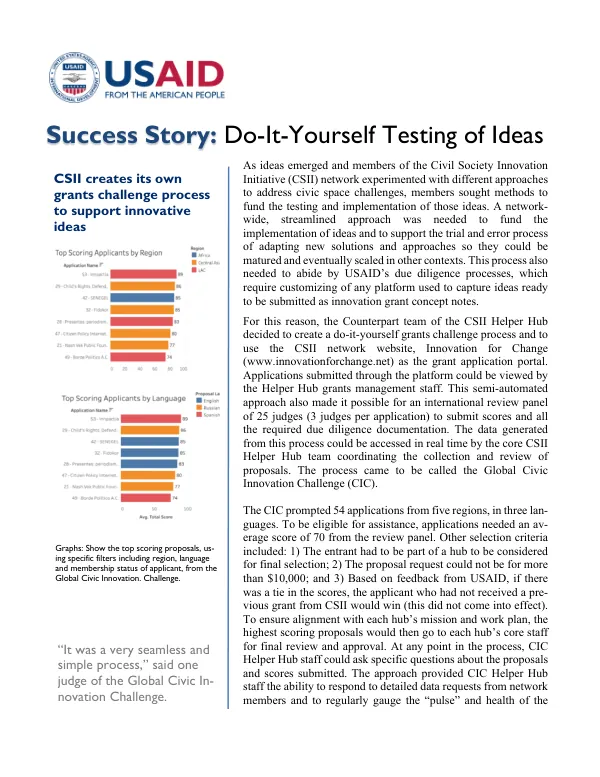
The process was designed to support innovative ideas and to fund the testing and implementation of those ideas. The challenge was launched on the CSII network website, Innovation for Change, which served as the grant application portal. The challenge prompted 54 applications from five regions, in three languages. To be eligible for assistance, applications needed an average score of 70 from the review panel. Other selection criteria included membership status of the applicant, with entrants needing to be part of a hub to be considered for final selection. The proposal request could not be for more than $10,000, and based on feedback from USAID, if there was a tie in the scores, the applicant who had not received a previous grant from CSII would win. The top scoring proposals, using specific filters including region, language, and membership status of applicant, are shown in a graph. The graph highlights the diversity of innovative ideas submitted from around the world. The winning proposals originated from the LAC, Central Africa, and Africa regions, and included Nash Vek Public Foundation, Presentes: Journalism, Gender and Human Rights, Child's Rights Defenders League, Fidokor, SENEGEL, Citizen Policy Internet Initiative, and Innpactia. The application process was praised by judges and participants for being fluid and straightforward. They referred to it as a "very seamless and simple" process that was transparent and professional. One judge noted that it was an interesting process to see different approaches for social innovations from around the world. Many respondents to a feedback survey expressed an interest in using a similar process for their work or in serving as a judge for future challenges. Potential areas for improvement of the judging process include reducing the number of forms to sign and the number of entries per judge, better facilitating the e-signature, or using one universal document to sign for all judged entries. Judges also indicated an interest in accessing other proposals during the process, developing online interaction with other judges, and connecting after the challenge to share ideas and comments. The low-cost, tested global process could be replicated to similar regional competitions and scaled out to the larger network.