USAID
Global Health Diagnostics Reference Guide
Laboratory testing provides objective data that healthcare professionals use to confirm or rule out diagnoses, guiding appropriate treatment decisions.
21 pages
Sign in to readA free account is required to download.
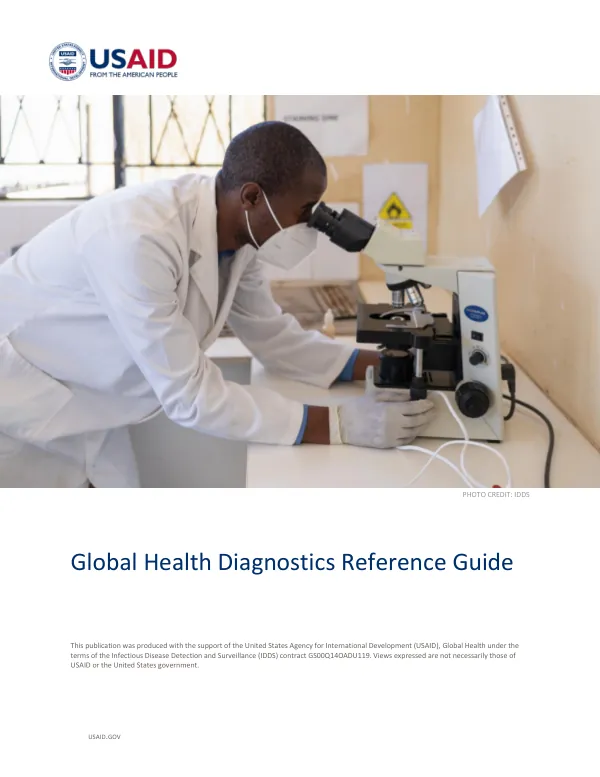
Abstract
Laboratory tests are also used to monitor disease progression, treatment efficacy, and patient response to therapy. Moreover, laboratory tests are instrumental in public health measures such as screening for diseases, detecting outbreaks, monitoring and controlling the spread of infectious diseases, supporting public health surveillance, and informing policies and interventions. The World Health Organization (WHO) categorizes pathogens based on their public health significance. Priority diseases pose the greatest public health risk due to their epidemic potential or lack of sufficient countermeasures. These diseases include COVID-19, Crimean-Congo hemorrhagic fever, Ebola virus disease, Marburg virus disease, Lassa fever, Middle East respiratory syndrome coronavirus and severe acute respiratory syndrome, Nipah and henipaviral diseases, Rift Valley fever, and Zika. Other pathogens of international public health concern include those that warrant attention due to their potential for causing significant morbidity and mortality on a global scale. In 2017, the WHO published a list of bacteria for which new antibiotics are urgently needed. The list is divided into three categories according to the urgency of need for new antibiotics: critical, high, and medium priority. The critical group includes bacteria resistant to many antibiotics, which pose a particular threat in hospitals and nursing homes, and among patients whose care requires devices such as ventilators and blood catheters. The high and medium priority categories contain other increasingly drug-resistant bacteria that cause more common diseases such as gonorrhea and salmonella. Multidrug-resistant bacteria in the critical and high categories are included in this diagnostics reference guide. Fungal priority pathogens are also listed in this reference guide. In 2022, the WHO published a list of fungal pathogens to be prioritized for research, development, and public health actions. The list includes fungal pathogens that can cause invasive acute and subacute systemic fungal infections for which drug resistance or other treatment and management challenges exist. Fungal pathogens included in the critical priority category are listed in this reference guide. Laboratory tests can be categorized into several types, including serological assays, molecular tests, microscopy tests, and matrix-assisted laser desorption/ionization time-of-flight (MALDI-TOF) tests. Serological assays detect the presence of antibodies produced by the immune system in response to a specific pathogen. Examples of serological assays include enzyme-linked immunosorbent assay (ELISA) and rapid diagnostic tests (RDTs). Molecular tests, also called nucleic acid tests, detect the pathogen's genetic material (nucleic acids, such as DNA or RNA) in a specimen to provide evidence of infection in the body. Examples of molecular tests include polymerase chain reaction (PCR) and nucleic acid sequencing. Microscopy tests involve visual examination of specimens under a microscope to directly observe the presence of pathogens. Examples of microscopy tests include light microscopy and fluorescence microscopy. Biosafety levels (BSLs) are a set of standards that define the protective measures necessary in a laboratory to ensure the safety of workers, the environment, and the public when handling potentially hazardous pathogens. These levels outline specific practices, safety protocols, and facility requirements tailored to the risk posed by specific pathogens. BSL designations are determined through biological risk assessments conducted for each experimental protocol, considering factors such as the infectious agent's transmission mode and potential harm. The gold standard refers to the diagnostic test or method considered the most accurate and reliable for detecting a particular pathogen. Gold standard tests are typically well-established, validated, and widely accepted within the medical community. They serve as a benchmark against which other diagnostic tests are evaluated and compared. In this reference guide, the gold standard or preferred tests are marked with a red asterisk (*).