INTERNATIONAL ORGANIZATION FOR MIGRATION
Government Negotiations with Gangs and Organized Crime: Spotlight
Government negotiations with gangs and organized crime have been a topic of debate in various countries in the Americas.
2016 · 2 pages
Sign in to readA free account is required to download.
Abstract
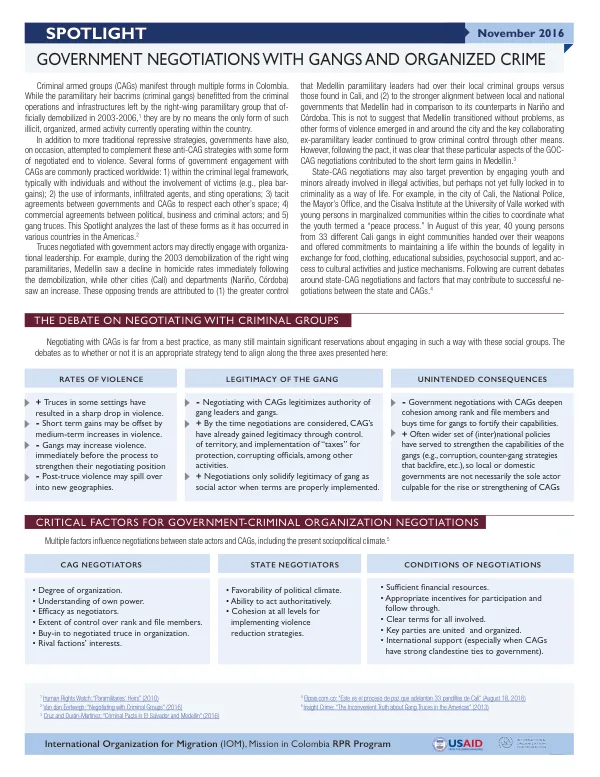
The International Organization for Migration (IOM), Mission in Colombia RPR Program, has analyzed the critical factors for government-criminal organization negotiations. Multiple factors influence these negotiations, including the present sociopolitical climate and the form of the criminal armed groups (CAGs) operating within a country. CAGs manifest through various forms in Colombia, including the paramilitary heir bacrims, which benefitted from the criminal operations and infrastructures left by the right-wing paramilitary group that officially demobilized in 2003-2006. Governments have attempted to complement anti-CAG strategies with negotiated ends to violence, using various forms of engagement, such as plea bargains, informants, infiltrated agents, sting operations, tacit agreements, commercial agreements, and gang truces. Truces negotiated with government actors may directly engage with organizational leadership, as seen in the 2003 demobilization of the right-wing paramilitaries in Medellin, which resulted in a decline in homicide rates. However, other cities and departments, such as Cali, Nariño, and Córdoba, saw an increase in violence due to factors such as the degree of organization, understanding of power, efficacy as negotiators, and control over rank and file members. State-CAG negotiations may also target prevention by engaging youth and minors involved in illegal activities. For example, in Cali, the National Police, the Mayor's Office, and the Cisalva Institute at the University of Valle worked with young persons in marginalized communities to coordinate a "peace process." In August of that year, 40 young persons from 33 different Cali gangs handed over their weapons and offered commitments to maintaining a life within the bounds of legality in exchange for food, clothing, educational subsidies, psychosocial support, and access to cultural activities and justice mechanisms. Negotiating with CAGs is a complex and fraught process, shaped by local histories and international interests. However, there are valuable lessons learned from previous processes that government representatives may find valuable when considering whether and how to engage with CAG actors. These lessons include addressing the underlying political and social welfare issues that contribute to gang activity, engaging with CAGs in a way that does not legitimize their authority, and providing clear terms and incentives for participation and follow-through. Notable CAG truces in the Americas include the Los Angeles Bloods and Crips truce, which lasted for ten years and resulted in a significant drop in homicide rates; the Barrio 18 and Mara Salvatrucha truce in El Salvador, which resulted in a precipitous drop in homicide rates but ultimately failed due to the government's inability to deliver on the gangs' demands; and the PCC truce in Sao Paulo, which lasted nearly six years and resulted in improved prison conditions and a reduction in violence. In conclusion, government negotiations with gangs and organized crime are a complex and multifaceted issue, influenced by various factors and shaped by local and international contexts. Addressing the underlying political and social welfare issues that contribute to gang activity, engaging with CAGs in a way that does not legitimize their authority, and providing clear terms and incentives for participation and follow-through are critical considerations for government representatives when considering whether and how to engage with CAG actors.