CARE
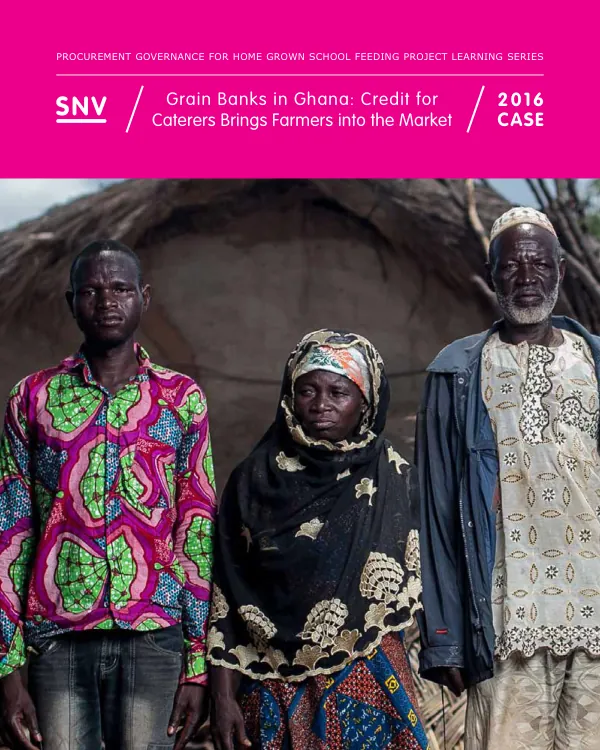
Grain Banks in Ghana: Credit for Caterers Brings Farmers into the Market
The grain bank model in Ghana's Sissala East District was developed to create a successful connection between smallholder farmers and the school feeding market.
2016 · 13 pages
Sign in to readA free account is required to download.
Abstract
This intervention model converts grain banks into a market channel and overcomes the reluctance of caterers to buy from local farmers due to late payments by the government. The model has been implemented by the Procurement Governance for Home Grown School Feeding (PG-HGSF) project since February 2014. The grain bank concept was initially developed in 2005 by ActionAid in partnership with the district Ministry of Food and Agriculture (MOFA) office and the local NGO ASUDEV. The grain banks were established to purchase and store excess harvest for the community to access during the lean season when consumer prices rise. Community members then buy back grain at reasonable prices, paying directly in cash or on credit. The credit is paid back in-kind with interest, i.e., with additional quantities of grain credited at the next harvest. The Ghana School Feeding Programme (GSFP) is part of Ghana's efforts to address the United Nations Millennium Development Goals on hunger, poverty, and primary education. The programme provides children in selected public primary schools and kindergartens with one hot, nutritious meal per day, using locally grown foodstuffs. However, the programme faces substantial challenges, particularly with the objective of using school feeding to boost domestic food production. GSFP does not document the use of local products, and there has not been any irrefutable evidence that increased production is attributable to the programme or that participation in the programme benefits smallholder farmers. SNV's innovative grain bank model was designed to tackle both issues, offering a new market prospect for grain banks and mitigating the perennial challenge of GSFP payment delays, which force caterers to buy products on credit. The project deployed small funds as loans to the grain banks to enable them to purchase grains from local farmers and supply to GSFP caterers within their areas. The District Assembly (DA) pays for the grains on behalf of the caterers by directly transferring the indebted amounts to the grain banks when caterers' funds are released by the Government of Ghana. The grain bank model relies on the involvement of the local commercial bank to facilitate direct payments into the grain bank's account and by the MOFA to build capacity of and monitor the management of the grain bank. The pilot began in February 2014 with five grain banks in the Sissala East district, and the first tranche of loans worth GHS 13,060 (around $3,300 USD) was released to grain banks in June 2014. With this initial loan, the grain banks stocked and supplied to 11 caterers a total of 59 100-kg bags of maize, 26 bags of beans, and 13 bags of groundnuts. Including subsequent tranches of GHS 8,280 ($2,100 USD) in October 2014 and GHS 10,338 ($2,600 USD) in January 2015, a total of 230 bags (23 MT) of maize, 28 bags (2.8 MT) of cowpea, and ten bags (1 MT) of groundnuts were purchased from 158 smallholder farmers (57 women, 101 men) by the grain banks of Sakai, Bujan, Kassana, Gwosi, and Banu. The Sakai Grain Bank, one of the grain banks involved in the project, has a comparative advantage in grain production due to its rich soil profile. The grain bank began operations in 2005 with seed capital of GHS 3,000 from ActionAid and has operated by buying, storing, and reselling maize to community members. With SNV's intervention, the bank currently supplies three caterers in the catchment area with maize, beans, and groundnuts on credit to feed the school pupils of the three communities. The Sakai Grain Bank is managed by a committee composed of four men and two women, who meet monthly as a team and hold weekly meetings at the facility to inspect the stocked grains and perform routine storage management.