USAID DEC
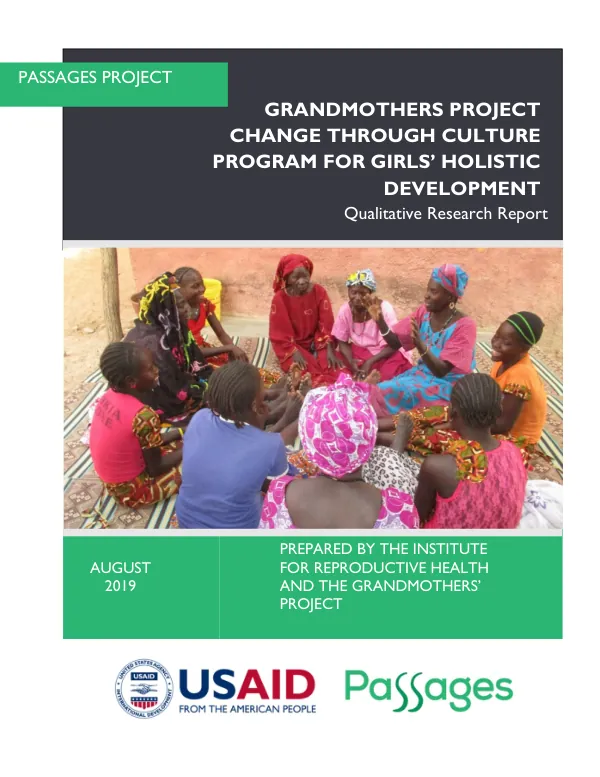
Grandmothers Project - Change through Culture: Program for Girls’ Holistic Development: Qualitative Research Report
Sign inINSTITUTO FOR REPRODUCTIVE HEALTH
Grandmothers Project - Change through Culture: Program for Girls’ Holistic Development: Qualitative Research Report
The Grandmothers Project - Change through Culture Program for Girls' Holistic Development is a community-based initiative that aims to promote change in culturally embedded social norms and practices related to girls' education, child marriage, extra marital teen pregnancy, and female genital mutilation/cutting (FGM/C).
2019 · 55 pages
Sign in to readA free account is required to download.
Abstract
The program is implemented in rural and urban areas in the Vélingara Department in Southern Senegal by the Grandmothers Project (GMP), a non-governmental organization that develops innovative community change strategies. The program, known as Girls' Holistic Development (GHD), promotes change by empowering girls and creating an enabling environment where family and community actors support change for girls. GMP uses a Change Through Culture approach, which builds on culturally-defined values, roles, and resources to preserve positive cultural elements that are beneficial to girls while discouraging harmful ones. This approach is particularly relevant in Vélingara, where family and community systems are characterized by age, generational, and gender hierarchies. In Vélingara, decision-making related to girls' development and wellbeing is collective in intergenerational families, and girls have limited voice. Elders, who are respected community members, men and women, are considered sources of wisdom and often use directive, top-down communication with adolescents. However, the role and influence of grandmothers and aunts, who traditionally had primary responsibility for the socialization of adolescent girls, have diminished in spite of their strong commitment to girls' development and wellbeing. To address these challenges, GMP's Change Through Culture methodology uses an inclusive and participatory approach that requires strong respect for local culture and values. The program aims to reduce child marriage, teen pregnancy, and FGM/C, and increase girls' school attendance by promoting change in culturally embedded social norms and practices. The program's strategy involves reviving culture and traditions, changing existing norms and practices, increasing the importance given to education, decreasing FGM/C, and towards improvement in gender inequalities. The program has observed changes in existing norms and practices, including increased importance given to education, decreasing FGM/C, and towards improvement in gender inequalities. Individual changes, such as skills, knowledge, and abilities, have also been observed, as well as collective changes, including collective actions driven by the project. The program has also noted beneficial effects of the selected approach, including strengthening the social fabric, restoring traditions and figures that inspire respect, and changing attitudes and practices related to social norms harmful to girls. The program's methodology has been evaluated through a qualitative study conducted in September 2018, which aimed to understand the processes of change and the effectiveness of the GHD program. The study found that the program has been successful in promoting change in culturally embedded social norms and practices related to girls' education, child marriage, extra marital teen pregnancy, and FGM/C. The study also noted that the program's approach has been effective in empowering girls and creating an enabling environment where family and community actors support change for girls. Overall, the Grandmothers Project - Change through Culture Program for Girls' Holistic Development is a community-based initiative that aims to promote change in culturally embedded social norms and practices related to girls' education, child marriage, extra marital teen pregnancy, and FGM/C. The program's approach has been effective in promoting change and empowering girls, and its methodology has been evaluated through a qualitative study.