INTERNATIONAL MONETARY FUND
Greenhouse Gas Emissions by Sector in Azerbaijan
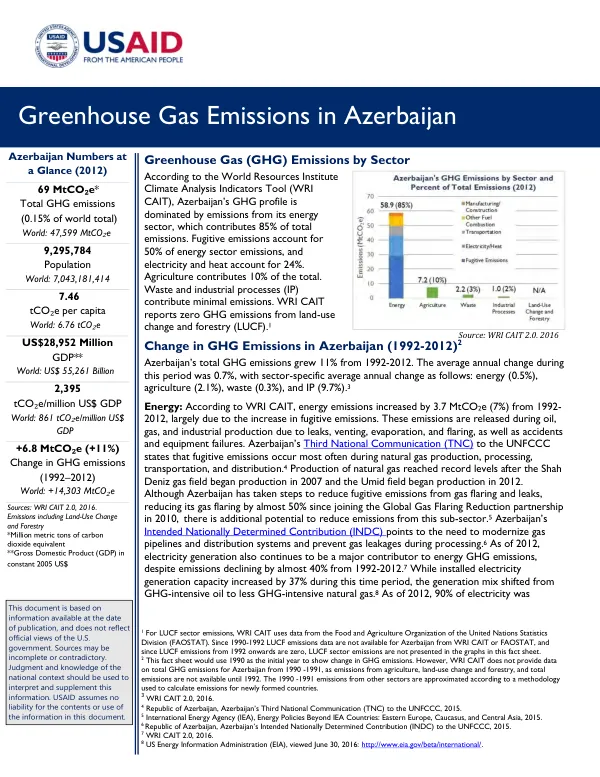
Azerbaijan's greenhouse gas (GHG) emissions are dominated by the energy sector, which contributes 85% of total emissions.
2016 · 2 pages
Sign in to readA free account is required to download.
Abstract
Fugitive emissions account for 50% of energy sector emissions, and electricity and heat account for 24%. Agriculture contributes 10% of the total, while waste and industrial processes contribute minimal emissions. Land-use change and forestry (LUCF) emissions are reported as zero. Azerbaijan's total GHG emissions grew 11% from 1992-2012, with an average annual change of 0.7%. The energy sector's average annual change was 0.5%, while agriculture's average annual change was 2.1%. Waste and industrial processes showed average annual changes of 0.3% and 9.7%, respectively. Energy emissions increased by 3.7 MtCO2e (7%) from 1992-2012, largely due to the increase in fugitive emissions. Fugitive emissions occur most often during natural gas production, processing, transportation, and distribution. Azerbaijan has taken steps to reduce fugitive emissions from gas flaring and leaks, but there is additional potential to reduce emissions from this sub-sector. The country's Intended Nationally Determined Contribution (INDC) points to the need to modernize gas pipelines and distribution systems and prevent gas leakages during processing. Azerbaijan's economy grew by 215% from 1992-2012, averaging 6.8% annually, while GHG emissions grew by 6.8 MtCO2e, averaging 0.7% annually. Azerbaijan's carbon intensity is more than double the world average, indicating potential to reduce GHG emissions relative to GDP. The country plans to reduce carbon intensity to OECD levels by the end of the decade, as stated in Azerbaijan 2020, the president's 2012 economic strategy. Azerbaijan's INDC expresses an absolute target to reduce emissions 35% below 1990 GHG levels by 2030. The country's economy is expected to grow by approximately 8% between 2014 and 2021. The INDC pledges to meet this target through mitigation measures, including raising awareness of energy efficiency, modernizing natural gas pipelines, preventing leakage during gas production, increasing development of renewable energy sources, developing public transit, methane capture from livestock sources, and planting new forests. Azerbaijan has developed policies and strategies to encourage renewable and alternative energy development, although implementation has been uneven. The government established a State Agency on Alternative and Renewable Energy Resources in 2009 to facilitate its 2005-2013 renewable energy strategy. A draft Law on Renewable Energy proposes incentives for renewable energy development, including a feed-in tariff and reduced tariffs on imported equipment.