USAID
Greenhouse Gas Emissions in Yemen
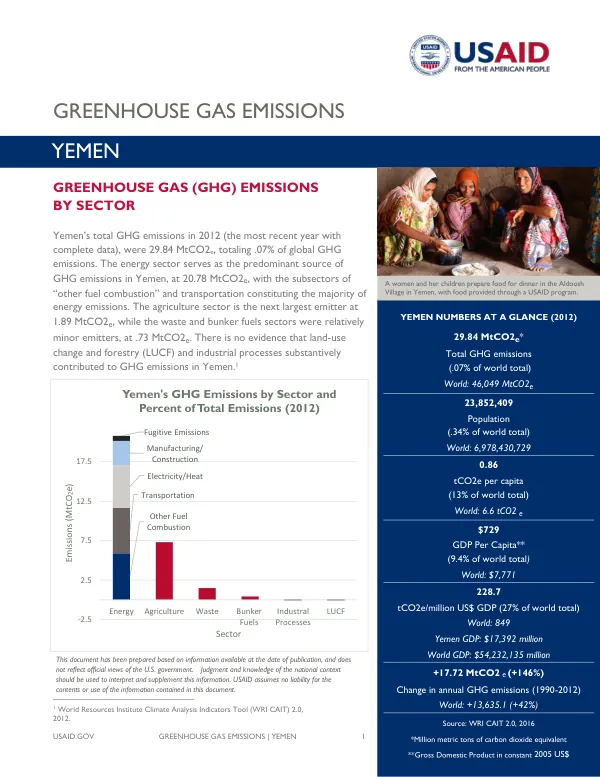
Yemen's total greenhouse gas (GHG) emissions in 2012 were 29.84 million metric tons of carbon dioxide equivalent (MtCO2e), accounting for 0.07% of global GHG emissions.
2017 · 3 pages
Sign in to readA free account is required to download.
Abstract
The energy sector was the predominant source of GHG emissions, contributing 20.78 MtCO2e, with the subsectors of "other fuel combustion" and transportation constituting the majority of energy emissions. The agriculture sector was the next largest emitter, accounting for 1.89 MtCO2e, while the waste and bunker fuels sectors were relatively minor emitters, at 0.73 MtCO2e. GHG emissions in Yemen increased by 146% between 1990 and 2012, with an average annual change of 4%. The energy sector had the largest overall increase in emissions during this period, from 6.56 MtCO2e in 1990 to 20.78 MtCO2e in 2012. Throughout, energy remained the largest contributor to GHG emissions, contributing 50% of total emissions in 1990 and 75% of total emissions in 2012. Contributions from electricity/heat and other fuel combustion increased the most within the sector, with electricity/heat emissions rising from 1.58 MtCO2e in 1990 to 5.38 MtCO2e in 2012, and other fuel combustion emissions increasing from 0.77 MtCO2e in 1990 to 5.91 MtCO2e in 2012. After energy, the agriculture sector saw the next largest increase in emissions during 1990-2012, from 4.39 MtCO2e in 1990 to 7.31 MtCO2e in 2012. Yemen's GDP increased from $7,858 million in 1990 to $17,392 million in 2012, which represents a slightly lesser rate than total GHG emissions from 1990 (12.12 MtCO2e) to 2012 (29.84 MtCO2e), signaling that carbon intensity has increased relative to 1990. Given that energy sector emissions make up the majority of total GHG emissions in Yemen, energy sector growth essentially mirrors total GHG emissions from 1990 to 2012. Yemen pledged to reduce emissions by 1% by 2030 as part of the United Nations Framework Convention on Climate Change (UNFCCC) Paris Agreement, and outlined an additional 13% reduction that could be achieved with international support. The country developed a mitigation scenario to reduce GHG emissions in the energy sector, which includes three key points: energy efficiency, fuel switching, and renewable energy. The mitigation scenario involves introducing efficient compact fluorescent lighting and efficient refrigeration in the residential sector, introducing fuel economy standards for light and heavy duty vehicles, and switching from diesel and residual fuel oil to natural gas in power generation, commercial bakeries, cement factories, and small industrial applications. The mitigation plan, if successfully implemented, is projected to result in sector-wide reductions in GHG by 2025 as follows: household (7.84%), industry (7.14%), transport (11.76%), commerce (9.38%), agriculture (40%), and total (11.44%). The plan also involves introducing large-scale, grid-connected geothermal, wind, and solar stations, as well as the widespread introduction of solar water pumps to replace diesel pumps in shallow wells.
Related documents