PRESIDENT'S EMERGENCY PLAN FOR THE U.S. FOR AIDS RELIEF
Haiti Country Profile
The U.S.
2016 · 2 pages
Sign in to readA free account is required to download.
Abstract
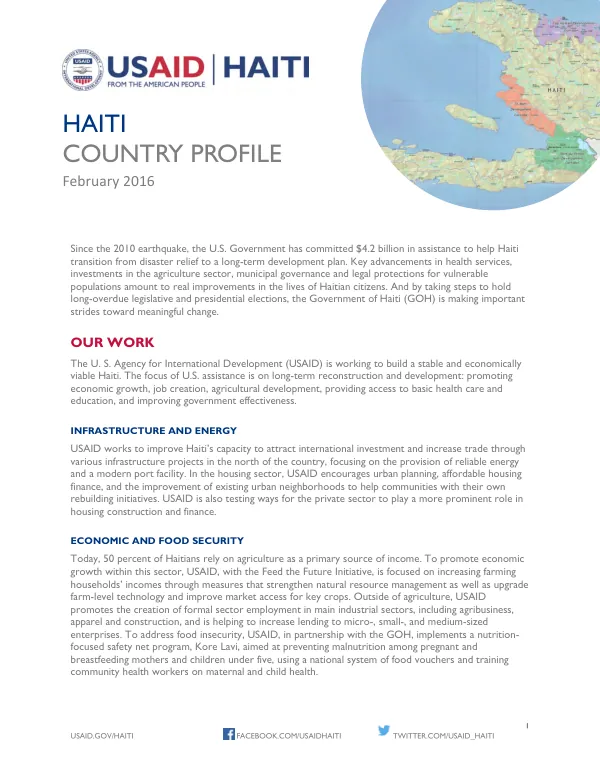
Government has committed $4.2 billion in assistance to help Haiti transition from disaster relief to a long-term development plan since the 2010 earthquake. Key areas of focus include health services, investments in the agriculture sector, municipal governance, and legal protections for vulnerable populations. The Government of Haiti (GOH) is making strides toward meaningful change by taking steps to hold overdue legislative and presidential elections. The U.S. Agency for International Development (USAID) is working to build a stable and economically viable Haiti. The focus of U.S. assistance is on long-term reconstruction and development, promoting economic growth, job creation, agricultural development, providing access to basic healthcare, and improving government effectiveness. USAID works to improve Haiti's capacity to attract international investment and increase trade through various infrastructure projects in the north of the country, focusing on the provision of reliable energy and a modern port facility. In the housing sector, USAID encourages urban planning, affordable housing finance, and the improvement of existing neighborhoods to help communities with their own rebuilding initiatives. USAID is also testing ways for the private sector to play a more prominent role in housing construction and finance. To promote economic growth within the agricultural sector, USAID, with the Feed the Future Initiative, is focused on strengthening natural resource management, upgrading farm-level technology, and improving market access for key crops. Roughly 50% of Haitians rely on agriculture as a primary source of income. To address food insecurity, USAID, in partnership with the GOH, implements a national system of food vouchers and trains community health workers in maternal and child health. The program, Kore Lavi, aims to prevent malnutrition among pregnant women, pregnant women, and children under five. USAID also supports a comprehensive early grade reading program, which trains teachers in modern methods, develops new materials in Kreyol and French, and improves learning outcomes for students. USAID works to strengthen the operations of local institutions, especially in the areas of human rights. The agency is building a network of local organizations to enable Haitians to participate in their country's development. Haiti is highly vulnerable to a range of hazards, including hurricanes, tropical storms, earthquakes, disease outbreaks, and droughts. The Office of Foreign Disaster Assistance maintains a permanent presence in Haiti and provides humanitarian aid to disaster-affected populations, as well as funding disaster risk reduction programs that increase community resilience and promote national self-sufficiency in emergency preparedness and management. The U.S. Agency for International Development works closely with the Haitian government, international donors, and multilateral institutions to increase aid effectiveness, accountability, and transparency. The goal is to help Haitians fight corruption and become responsible stewards of public finances. Haiti ranks 161 out of 168 on the Corruption Perception Index and 138 out of 188 on the Gender Inequality Index. The country faces significant challenges, including high unemployment, poverty, and limited access to healthcare.
Related documents