USAID
Healthcare Operations Management and Policy
Healthcare operations management is a critical component of healthcare delivery, encompassing the processes and systems necessary to provide high-quality patient care.
32 pages
Sign in to readA free account is required to download.
Abstract
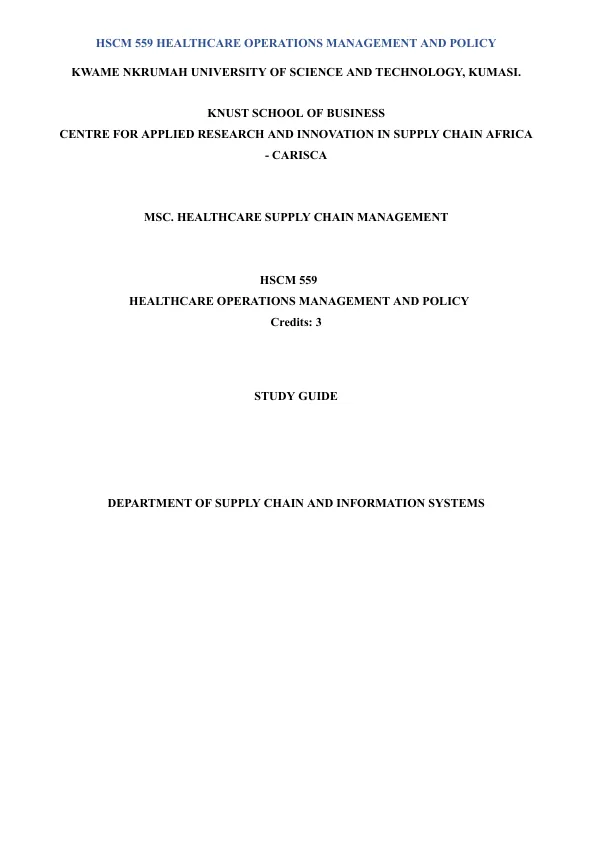
The healthcare industry is diverse, comprising institutions and practitioners that provide services for diagnosis, treatment, and prevention of injury, illness, disease, and other physical and mental impairments. Healthcare is composed of primary, secondary, and tertiary care, with social and economic conditions significantly affecting access to healthcare. Managing healthcare service operations involves designing the service enterprise, quantitative models for health service operations, healthcare resources management, understanding customers and relationship management, managing supply networks and supplier relationships, and healthcare quality management. Effective healthcare operations management requires efficient process flow, change management, and quality standards, similar to production facilities. The course HSCM 559 Healthcare Operations Management and Policy covers seven units, each focusing on specific topics. Unit one covers managing healthcare service operations, including health operations management, frameworks for health operations management, and change management. Unit two focuses on designing the service enterprise, including health service development, the service encounter, and supporting facility and process flow. Quantitative models for health service operations are essential for forecasting demand for services, managing service inventory, and managing service projects. Healthcare resources management involves logistics management, human resources management, financial management, and estates and facilities management. Understanding customers and relationship management is critical for designing the customer experience, developing good business relationships, and managing customer expectations and perceptions. Managing supply networks and supplier relationships involves supply chains and networks, the role of information and inventory, and hospital inventory management for pharmaceuticals. Healthcare quality management includes introduction to healthcare operations quality management, healthcare quality management building blocks, measuring healthcare operations performance, and continuous improvement of healthcare operations. The course utilizes various learning materials, including textbooks, case studies, and academic articles. The recommended learning materials include "Service Operations Management: Improving Service Delivery" by Robert Johnston, Graham Clark, and Michael Shulver, and "Health Operations Management: Patient Flow Logistics in Health Care" by Jan Vissers and Roger Beech. The course delivery includes lectures, small group practices, discussions, demonstrations, audio-visual presentations, and student presentations. Grading is based on individual and group assignments, participation in group discussions, mid-semester examination, and end-of-term examinations. Academic and scientific writing skills are essential for all assignments, and students are required to follow the standards of scientific writing. The course aims to equip students with the knowledge and skills necessary to manage healthcare operations effectively, ensuring the delivery of consistent, high-quality, person-centric care. By understanding the principles, approaches, strategies, and techniques of healthcare operations management, students can analyze and identify strategies to improve the operational performance of healthcare organizations.
Related documents