USAID DEC
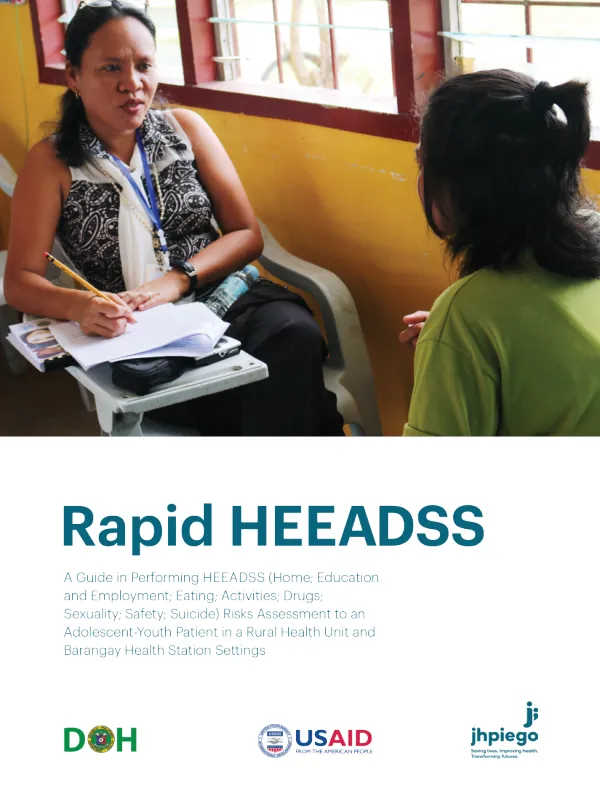
HEEADSS Psychosocial Risks Assessment: A Background and Guide for Rural Health Units
Sign inWORLD HEALTH ORGANIZATION
HEEADSS Psychosocial Risks Assessment: A Background and Guide for Rural Health Units
Adolescent-youth (AY) patients are at high risk for psychosocial issues, including unplanned teen pregnancy, sexually transmitted infections (STIs), alcohol and substance use and abuse, assault, depression, and suicide.
2018 · 16 pages
Sign in to readA free account is required to download.
Abstract
These concerns pose significant threats to young people's health and development. Risky behaviors often go undetected during standard history-taking by health providers or guidance counselors, resulting in delayed preventive interventions. The Department of Health's Adolescent Health and Development Program promotes the integration of HEEADSS psychosocial risks assessment as a standard procedure when dealing with AY patients. The HEEADSS system, originally developed by Dr. Henry Berman in 1972 and refined by Dr. Eric Cohen, is an acronym that stands for questions related to Home environment, Education, Employment/Eating habits, Activities that are peer-related, Drugs, Sexuality, and Suicide/Depression/Abuse. This system has been successfully used by adolescent clinics in the United States and other countries, and has been adopted by the World Health Organization and the Society of Adolescent Medicine of the Philippines. Integrating HEEADSS psychosocial risks assessment in rural health units' (RHU) daily routine operations involves a step-by-step process. The first step is to register the AY patient and obtain their personal information and reason for consult. The patient is then instructed to fill out a Rapid HEEADSS Assessment Form, which is a confidential and anonymous questionnaire that assesses their psychosocial risks. The form is then attached to the patient's medical records. The second step involves taking the patient's history and anthropometric measurements, including their chief complaint, medical history, family history, vital signs, and anthropometric signs. The third step is to manage the patient's medical concerns and provide psychosocial risks guidance and counseling. This involves reviewing the patient's responses on the Rapid HEEADSS Assessment Form, performing a physical examination, and managing any medical concerns. If the patient indicates that they are engaged in health-risky behaviors or experiencing abuse, the health provider will spend additional time with the patient to provide guidance and counseling. The goal of the HEEADSS psychosocial risks assessment is to provide guidance, counseling, and services to prevent health and development consequences of risks. By integrating this assessment into RHU daily routine operations, health providers can identify and address psychosocial issues early on, reducing the risk of morbidity and mortality among AY patients.