USAID DEC
Holistic Grazing Planning Trainer of Trainers Workshop Report
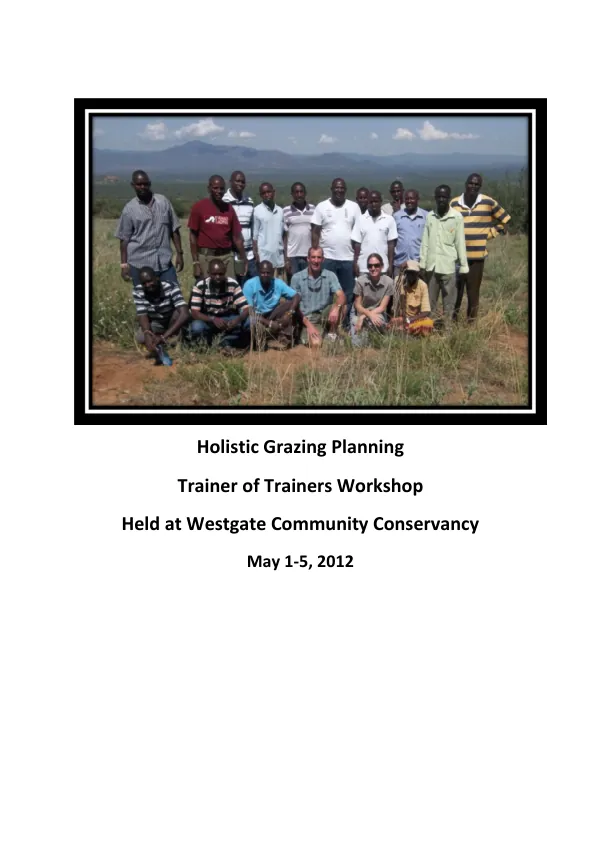
Holistic Grazing Planning Training-of-Trainers Workshop was held at Westgate Community Conservancy from May 1-5, 2012.
2012 · 11 pages
Sign in to readA free account is required to download.
Abstract
The workshop aimed to equip participants with skills to develop and facilitate holistic grazing plans in their respective conservancies. The training focused on creating a context for grazing planning, decision-making structures, ecosystem processes, and tools for managing these processes. The workshop began with introductions and exercises to familiarize participants with each other and the scope of the training. Participants included conservancy managers, grazing coordinators, and other stakeholders from various conservancies in the region. The training materials, including the NRT Grazing Planning Training Manual, were distributed to participants, along with other resources such as notebooks, pens, and colored markers. The training modules followed the format of the NRT Grazing Planning Training Manual, which emphasized the importance of understanding the "Whole under Management." This concept involves defining the boundaries of what is being managed, including natural resources such as grass, water, soil, wildlife, livestock, and land. The trainees were also introduced to the concept of ecosystem processes, which includes energy flow, water cycle, mineral cycle, and biodiversity. The trainees were divided into groups to prepare presentations on each of the ecosystem processes. They were encouraged to use the training manual as a reference and to tie the processes back to each other. The presentations highlighted the importance of indigenous knowledge and alternative examples, such as plants seeking sunlight, to interpret the processes. The workshop also included a reflection exercise, where trainees were asked to reflect on their experiences and turn in written responses to questions such as what they hoped to take away from the training and how they would use the collective vision for grazing planning. The reflections provided valuable insights into the trainees' understanding of the concepts and their ability to apply them in their work. Throughout the workshop, participants were encouraged to share their stories and experiences, which helped to create a sense of community and camaraderie. The stories also provided valuable lessons and insights into the challenges and opportunities faced by the conservancies. The workshop concluded with a review of the key takeaways and a discussion of the next steps for the trainees. The training was designed to equip participants with the skills and knowledge necessary to develop and facilitate holistic grazing plans in their conservancies, with a focus on creating a collective vision for sustainable land use and management. The collective vision, which was developed through a participatory mapping exercise, emphasized the importance of healthy people and animals, income-generating activities, healthy grasslands, good leadership, and peaceful relationships. The vision was developed through a collaborative effort among the trainees, who represented different stakeholder groups, including women, youth, and elders. The workshop highlighted the importance of holistic grazing planning in conservancies, which involves managing the entire ecosystem, including natural resources, to achieve sustainable land use and management. The training provided participants with the skills and knowledge necessary to develop and facilitate holistic grazing plans, which can help to improve the livelihoods of communities and conserve natural resources. The training also emphasized the importance of indigenous knowledge and alternative examples, such as plants seeking sunlight, to interpret ecosystem processes. This approach recognizes the value of traditional knowledge and practices in managing natural resources and achieving sustainable land use. Overall, the Holistic Grazing Planning Training-of-Trainers Workshop provided participants with the skills and knowledge necessary to develop and facilitate holistic grazing plans in their conservancies. The training emphasized the importance of creating a collective vision for sustainable land use and management, which involves managing the entire ecosystem, including natural resources, to achieve sustainable land use and management.
Related documents