USAID DEC
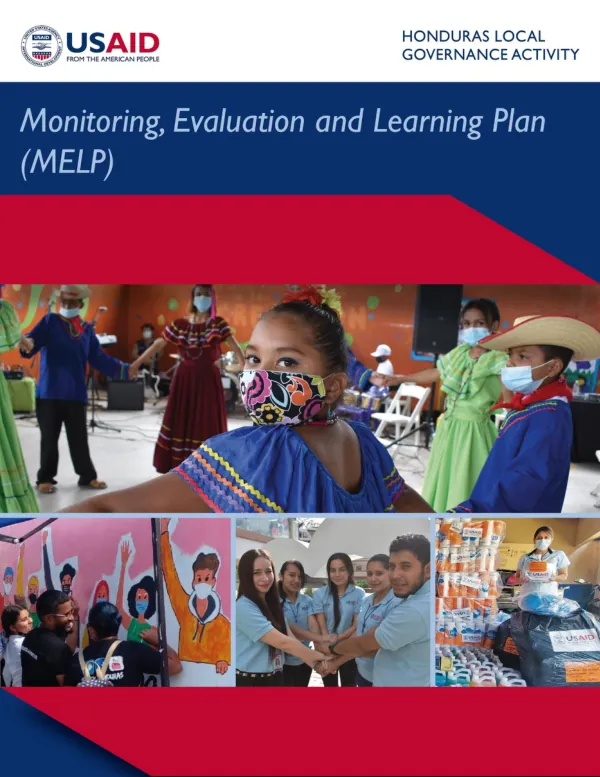
Honduras Local Governance Activity Monitoring, Evaluation and Learning Plan (MELP) Revision #5
Sign inDAI GLOBAL, LLC
Honduras Local Governance Activity Monitoring, Evaluation and Learning Plan (MELP) Revision #5
The Honduras Local Governance Activity (HLG) is a USAID-funded program aimed at enhancing service delivery provision through increased citizen influence and improved governance in western Honduras.
2021 · 32 pages
Sign in to readA free account is required to download.
Abstract
The program was initiated in 2016 to address extreme poverty in the region. Initially, the program focused on expanding and deepening USAID investments in nutrition, water, education, and other critical services. The program's approach to governance was centered on strengthening actions at subnational levels, where basic services are delivered and citizens interact with the government. This involved working with local government entities, civil society organizations, and other stakeholders to improve service delivery and increase citizen participation in decision-making processes. In July 2019, USAID programming funds were reduced, impacting the program's capacity to operate in the field. In response, the program submitted two revisions to the approved Work Plan, as well as an Emergency Action Plan, outlining reductions in personnel, subcontractors, and technical activities. By September 2019, the program had reduced 77% of all personnel across central and regional offices and decreased the number of targeted municipalities from 89 to 40. The program underwent significant restructuring and consolidation, transitioning from six to two regional offices and eliminating positions in water and sanitation, nutrition, municipal finance, and municipal association specialists. The program also developed a second revision to the Monitoring, Evaluation, and Learning Plan (MELP) in November 2019, which reflected the reduced funding and impact on the program's activities. In March 2020, the COVID-19 pandemic was declared in Honduras, leading to the pause or modification of several activities in the approved Fiscal Year 2020 Work Plan. The program adjusted its target for the indicator "Citizens' participation rate for decision making related to the provision of services" downward and transitioned to remote monitoring processes in line with USAID's guidance. In August 2020, USAID expanded the program into targeted neighborhoods in five municipalities in the northern and central regions of the country, corresponding to high-crime urban areas. This expansion led to the development of a fourth revision to the MELP, which included the incorporation of a new lower-level indicator, adjustments to data collection and verification standards, and revisions to the program's annual targets for FY2021 and FY2022. In May 2021, USAID expanded the program's focus to include helping to reduce irregular migration and building a Positive Youth Development (PYD) approach across all activities. The MELP was revised to align with this new focus and the FY2022 Work Plan. The program's revised MELP reflects the changes in approaches and conditions during the life of the Activity and includes a summary of all changes incorporated into the document. The program's Monitoring, Evaluation, and Learning Plan (MELP) is a critical component of the HLG Activity, providing a framework for monitoring and evaluating the program's progress and impact. The MELP includes 17 indicators to measure the program's progress, including three standard indicators and 14 customized indicators defined directly by the program. The indicators are designed to measure two results and five sub-results, reflecting the program's expected impact and results. The program's MELP is structured into three tiers: internal learning and reflection, external evaluation, and local feedback. The internal learning and reflection tier involves regular monitoring and evaluation of the program's progress, using data from the program's monitoring IT system and data quality assessments. The external evaluation tier involves independent evaluations of the program's impact and effectiveness, using a range of methods and tools. The local feedback tier involves collecting feedback from local stakeholders, including citizens, government officials, and civil society organizations, to inform program design and implementation. The program's data management system is critical to its monitoring and evaluation efforts, providing a framework for collecting, analyzing, and reporting data on the program's progress and impact. The system includes a range of tools and technologies, including a management information system (MIS), a data quality assessment form, and a performance indicator reference sheet (PIRS). The program's data management system is designed to ensure the accuracy, reliability, and consistency of data, and to provide a clear and transparent picture of the program's progress and impact. The program's indicators are designed to measure a range of outcomes and impacts, including citizen participation in decision-making processes, service delivery, and governance. The indicators are also designed to reflect the program's focus on reducing irregular migration and building a Positive Youth Development (PYD) approach. The program's indicators are structured into three categories: results, sub-results, and lower-level indicators. The results indicators measure the program's overall impact and effectiveness, while the sub-results indicators measure specific aspects of the program's impact. The lower-level indicators measure specific activities and outputs, providing a detailed picture of the program's progress and impact. The program's MELP is revised regularly to reflect changes in the program's design and implementation, as well as changes in the context and environment in which the program operates. The revisions are designed to ensure that the program remains relevant and effective, and to ensure