DAI GLOBAL, LLC
Quarterly Report: School-Based Violence Prevention Activity FY 2019 Quarter 1I
The School-Based Violence Prevention Activity (SBVPA) in Honduras is a five-year initiative launched in February 2017, with the goal of reducing school-based violence and promoting violence prevention in target communities.
2019 · 75 pages
Sign in to readA free account is required to download.
Abstract
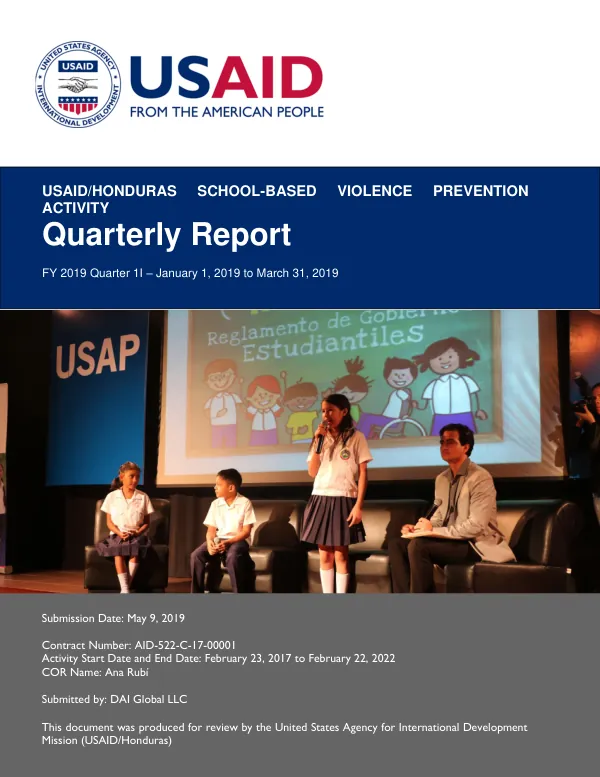
The activity is implemented by DAI Global LLC, with support from subcontractor Partners of the Americas, and works from a central project office in Tegucigalpa, as well as two field offices in San Pedro Sula and La Ceiba. The project has four objectives: to improve schools' ability to reduce school-based violence through the creation of safe learning environments, to strengthen local networks that increase school safety, to increase the capacity of the Ministry of Education and social protection actors to prevent and respond to school-based violence, and to lower risk factors and enhance protective factors for students who qualify for secondary prevention services. During the first quarter of 2019, the project launched activities in 49 new schools, increasing coverage to a total of 115 schools. The project also hosted three regional forums on student government by laws and civic participation values, reaching over 665 students from 116 schools. Additionally, the project expanded its fellowship program, recruiting 53 new university fellows to assist with school-based violence prevention activities in schools. The project also made progress in the area of social-emotional learning (SEL), training 38 expert facilitators at the national level and 58 physical education master trainers who will train their peers. Furthermore, the project revised and finalized Module I and II of the Educators for Peace teacher professional development program and trained a total of 795 teachers and administrators on Module I in target schools. To enhance principals' skills as leaders in contexts of violence and conflict, the project launched an Executive Program for Leadership in Education, offering the first of five half-day sessions to 116 principals and assistant principals from 109 schools in Tegucigalpa, San Pedro Sula, and La Ceiba. The project also enhanced the social asset network by completing the electronic mapping of community and social protection actors for 116 schools, an average of 5-8 actors per school. The project hosted a total of eleven opportunity fairs in four of the five target cities, benefiting a total of 4,775 students, 174 teachers, and 15 principals. Representatives from 115 organizations participated, including local partners, public institutions, and private sector businesses. The project also brought students from nine schools on ten Day of Dreams visits to six local businesses and one university, in partnership with United Way, CEUTEC, and EMSULA, benefiting 13 teachers and 262 students. The project's activities are aligned with the Government of Honduras' 2010 Country Vision on non-violence and security, as well as The Law of Fundamental Education, which highlights prevention and rehabilitation as a crosscutting issue in the national curriculum. The project also aligns with the US State Department's Central American Regional Security Initiative (CARSI) and the 2014 Alliance for Prosperity, a regional initiative aimed at reducing the incentives for migration.