USAID DEC
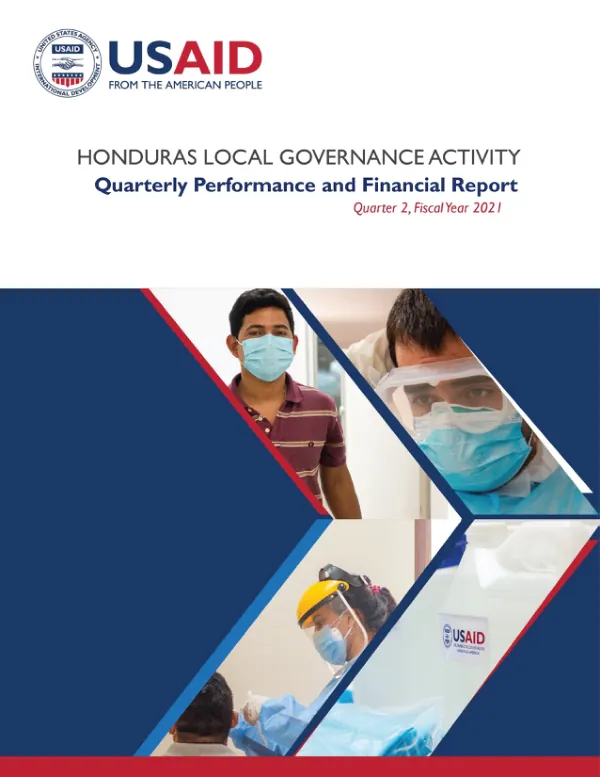
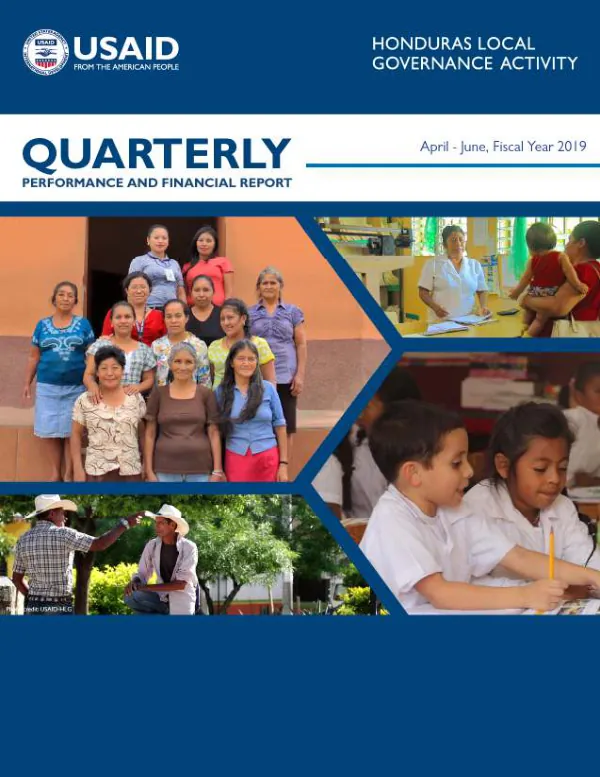
Honduras Local Governance Activity Quarterly Performance and Financial Report April 1, 2019 – July 31, 2019
Sign inDAI GLOBAL, LLC
Honduras Local Governance Activity Quarterly Performance and Financial Report April 1, 2019 – July 31, 2019
The Honduras Local Governance Activity adapted to complex changes in United States Government foreign assistance policy for Honduras during the third quarter of Fiscal Year 2019.
2019 · 46 pages
Sign in to readA free account is required to download.
Abstract
Prior to receiving official guidance in July 2019 that USAID would not be obligating FY 2018 funding, the Activity took proactive steps to begin reducing expenditures. A modified work plan was approved on May 17, 2019, outlining technical adjustments to close technical assistance cycles and focus on actions necessary to achieve the results framework of the Activity. The consolidated technical focus of the Activity resulted in a reduction in personnel by 39 staff during the quarter, including 10 subcontractor embedded staff. The Activity continued to make advances toward the achievement of the Task Order development hypothesis, which posits that improved capacity of civil society groups and community organizations to advocate for their needs and priorities, and more effective local government and service provider institutions, will lead to improved systems for quality and access of key services being delivered. Technical assistance has worked to strengthen citizen participation and oversight, while also improving service provider and local government management capacity. By fortifying both the demand (civil society) and supply (service provider and local government) side of service delivery, the Activity has supported these actors to cultivate a cycle of demand-to-action that has led to tangible improvements in water and sanitation, nutrition, and education service delivery. The Activity has also responded to the U.S. Government's programmatic shift to focus more on migration by launching a case study on migration in four prioritized municipalities: Copan Ruinas, Macuelizo, San Marcos, and Gracias. These municipalities are among the highest receptors of returned migrants in western Honduras, according to the National Center for Social Sector Information. The Activity worked to sensitize these municipalities on migration and discuss their local migration context, and following four forums with citizens, service providers, private sector, and local government actors, these four municipalities are now in the process of developing initiatives that respond to local problems related to migration. The local government of Copán Ruinas will collaborate with World Vision and the Activity to establish a youth entrepreneurship fund where participants will either be returned youth migrants or youth at-risk of migrating due to economic or social vulnerability. The goal of the case study is to increase the four local governments' capacity to implement actions that attend to returned migrants and reduce the intention to migrate. The Activity's efforts to strengthen citizen engagement and local government capacity to improve service delivery are critical in addressing the needs of returned migrants and reducing poverty in western Honduras. The Activity's Citizen Satisfaction Survey conducted by the USAID Monitoring and Evaluation Support for Collaborative Learning (MESCLA) Activity in 2018 found that 24% of individuals in western Honduras expressed an intention to migrate. The municipalities covered by the Activity have received 25,391 returned migrants since 2016. The Activity's focus on improving service delivery and addressing the needs of returned migrants is essential in addressing the root causes of migration and promoting sustainable development in western Honduras. The Activity's technical assistance has worked to strengthen citizen participation and oversight, while also improving service provider and local government management capacity. By fortifying both the demand (civil society) and supply (service provider and local government) side of service delivery, the Activity has supported these actors to cultivate a cycle of demand-to-action that has led to tangible improvements in water and sanitation, nutrition, and education service delivery. The Activity's efforts to address the needs of returned migrants and reduce poverty in western Honduras are critical in promoting sustainable development and reducing the intention to migrate.