CRS
Humanitarian Response to the Nepal Earthquake in FY 2015
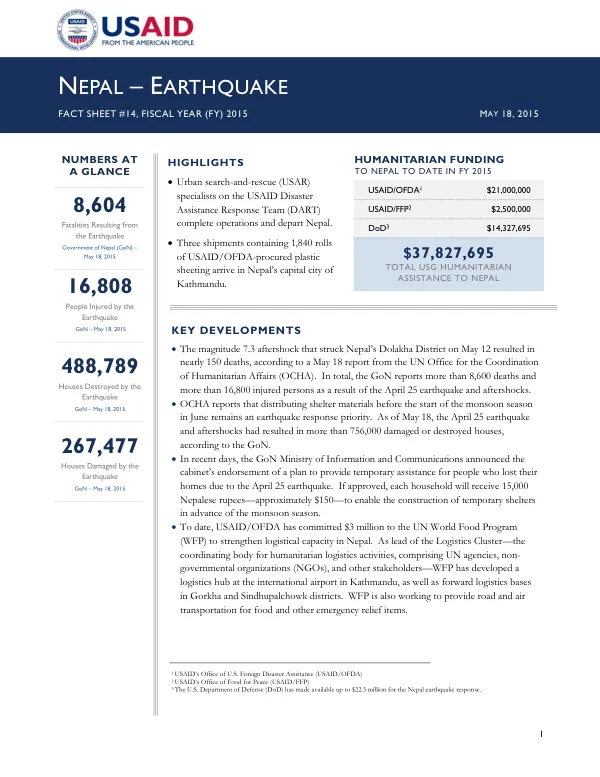
The magnitude 7.3 aftershock that struck Nepal's Dolakha District on May 12 resulted in nearly 50 deaths, according to a report from the Government of Nepal (GoN).
2015 · 6 pages
Sign in to readA free account is required to download.
Abstract
The total death toll from the April 25 earthquake and aftershocks is estimated to be more than 8,600, with over 16,800 people injured. The GoN reports that nearly 756,000 houses were damaged or destroyed, with 488,789 houses completely destroyed and 267,477 houses partially damaged. The distribution of shelter materials before the monsoon season in June remains a priority for the GoN. As of May 18, the GoN Ministry of Information and Communications announced the endorsement of a plan to provide temporary assistance for people who lost their homes due to the April 25 earthquake. Each household will receive 15,000 Nepalese rupees, approximately $150, to enable the construction of temporary shelters in advance of the monsoon season. The United States Agency for International Development (USAID) has committed $4 million to the UN World Food Program (WFP) to strengthen logistical capacity in Nepal. As the lead of the Humanitarian Logistics Cluster, the WFP has developed a logistics hub at the international airport in Kathmandu and forward logistics bases in Gorkha and Sindhupalchowk districts. The WFP is also working to provide road and air transportation for food and other emergency relief items. The USAID has also committed $22.5 million to the Nepal earthquake response, with $21 million allocated to USAID's Office of U.S. Foreign Disaster Assistance (USAID/OFDA) and $1.5 million to USAID's Office of Food for Peace (USAID/FFP). The U.S. Department of Defense (DoD) has also made available up to $22.5 million for the Nepal earthquake response. The USAID/OFDA has provided more than $6 million to provide logistics support and emergency commodities to respond to the April 25 earthquake and aftershocks in Nepal. The USAID/OFDA is also supporting the International Organization for Migration (IOM), the International Rescue Committee (IRC), and Save the Children (SC) to provide relief commodities to populations in districts that experienced the most severe earthquake damage. The USAID/OFDA has also committed nearly $549,000 to support shelter interventions, including the distribution of plastic sheeting and other shelter materials. The IOM is finalizing assessments of 11 earthquake-affected districts outside of the Kathmandu Valley and plans to launch a second round of the Displacement Tracking Matrix in the coming days. The GoN Prime Minister Sushil Koirala has appealed for $2 billion in international assistance to support rebuilding and economic recovery efforts. The GoN has allotted $200 million toward the national rehabilitation and reconstruction fund and is seeking additional support from donors and the private sector. As of May 18, international donors have contributed nearly $216 million to the Nepal earthquake response, with the USG being the largest international donor.