CRS
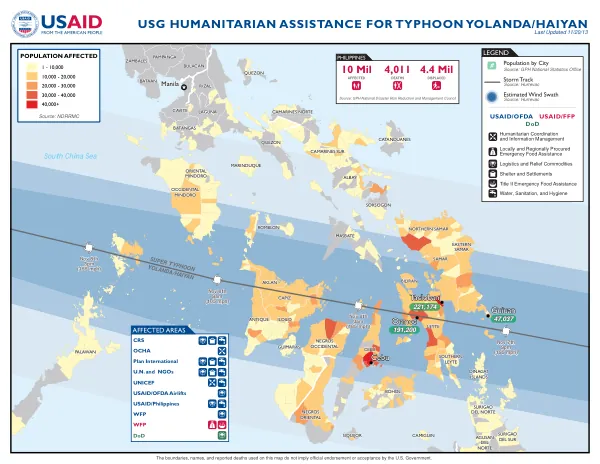
USG HUMANITARIAN ASSISTANCE FOR TYPHOON YOLANDA/HAIYAN
The Super Typhoon Yolanda/Haiyan made landfall in the Philippines on November 7th, 2013, with sustained winds of 195 miles per hour.
2013 · 1 pages
Sign in to readA free account is required to download.
Abstract
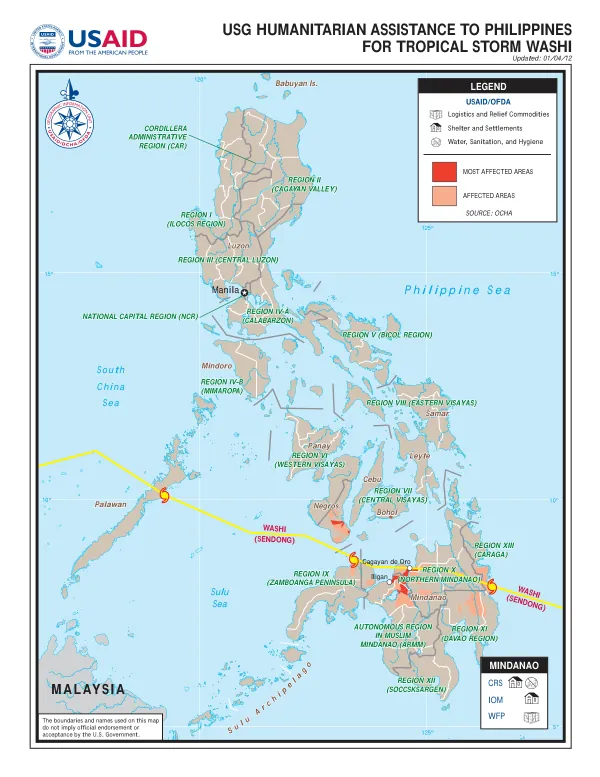
The storm's trajectory took it across several provinces, including Leyte, Iloilo, Quezon, Palawan, Cebu, Samar, Bohol, and others. The storm's wind speed decreased over the course of November 8th, with readings of 185 miles per hour at 3am, 165 miles per hour at 9am, and 155 miles per hour at 3pm. The provinces of Leyte, Iloilo, and Cebu were among the most severely affected areas, with widespread destruction reported in cities such as Tacloban, Ormoc, and Guiuan. The storm surge caused significant flooding and damage to coastal communities, resulting in extensive loss of life and property. According to the GPH National Disaster Risk Reduction and Management Council, the storm affected over 10 million people, with 4.4 million displaced and 4,011 reported deaths. The population affected by the storm was categorized into five groups, with the largest number of people (40,000+) affected in the provinces of Leyte, Iloilo, and Cebu. Humanitarian assistance was provided by various organizations, including the United Nations, non-governmental organizations (NGOs), and the U.S. Government. The USAID/OFDA airlifted relief commodities, while the WFP provided emergency food assistance. The DoD and locally procured logistics and relief commodities were also used to support the relief efforts. The humanitarian coordination and information management were facilitated by the Humanitarian Coordination and Information Management team. The U.S. Government provided significant humanitarian assistance to the affected areas, with a focus on emergency food assistance, shelter and settlements, and water, sanitation, and hygiene. The assistance was provided through various channels, including Title II Emergency Food Assistance and locally and regionally procured emergency food assistance. The U.S. Government's humanitarian assistance was coordinated with the local authorities and other stakeholders to ensure effective delivery of aid to the affected communities.
Related documents