USAID DEC
ICT-Enabled Agricultural Extension in the Democratic Republic of the Congo: Policy Brief
Sign inUSAID DEC
ICT-Enabled Agricultural Extension in the Democratic Republic of the Congo: Policy Brief
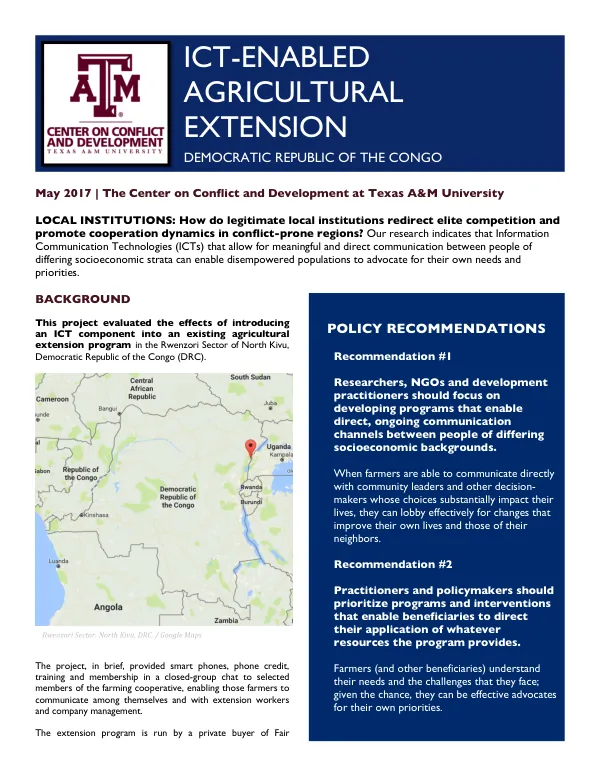
The agricultural extension program in the Rwenzori Sector of North Kivu, Democratic Republic of the Congo, was evaluated to assess the impact of introducing Information Communication Technologies (ICTs) on the effectiveness of the program.
2020 · 2 pages
Sign in to readA free account is required to download.
Abstract
The project provided smart phones, phone credit, training, and membership in a closed-group chat to selected members of the farming cooperative, enabling them to communicate among themselves and with extension workers and company management. The extension program, run by a private buyer of Fair Trade cacao, is one of the few sources of reliable agricultural information in the communities in which it is active. Cacao is a cash crop that affords farmers a reasonable living in the area, where average annual incomes are under $400 and localized rebel activity and general insecurity make agriculture a risky investment. The ICT intervention focused on the introduction of internet-connected mobile phones and communication tools, such as farmer group chats in the WhatsApp application, among members of the growing cooperative. The project aimed to see if ICT-enabled extension could engender greater participation in the farmer cooperative, enable better dissemination and communication of cultivation and production guidance, and enable smallholders in the farmer cooperative to collaborate more effectively and extensively with each other, with extension workers, and with management of the farmer cooperative. Analysis and conclusions are based on household surveys, focus groups, and key informant interviews, along with extensive informal conversations with farmers, extension agents, and company management. The evidence from the study suggests that the ICT intervention decreased the incidence of primary farming challenges, such as delayed payments for crops sold, among the farmers involved. Farmers with project phones were able to leverage their enhanced access to extension agents and company staff and management to push for more timely payments for themselves and for the other members of their growing cooperative. However, without concurrent investments in extension infrastructure, the project did not register significant successes in communication frequency among farmers, overall farmer participation in the cooperative, or improvements in the effectiveness of information dissemination regarding cultivation and production. The study's findings suggest that ICT-enabled extension can be an effective tool for improving the lives of farmers in conflict-prone regions. By enabling direct, ongoing communication channels between people of differing socioeconomic backgrounds, ICTs can empower disempowered populations to advocate for their own needs and priorities. The study's recommendations include focusing on developing programs that enable direct, ongoing communication channels between people of differing socioeconomic backgrounds and prioritizing programs and interventions that enable beneficiaries to direct their application of whatever resources the program provides.