PALLADIUM INTERNATIONAL, LLC
IHP Facility and Financial Management Technical Brief
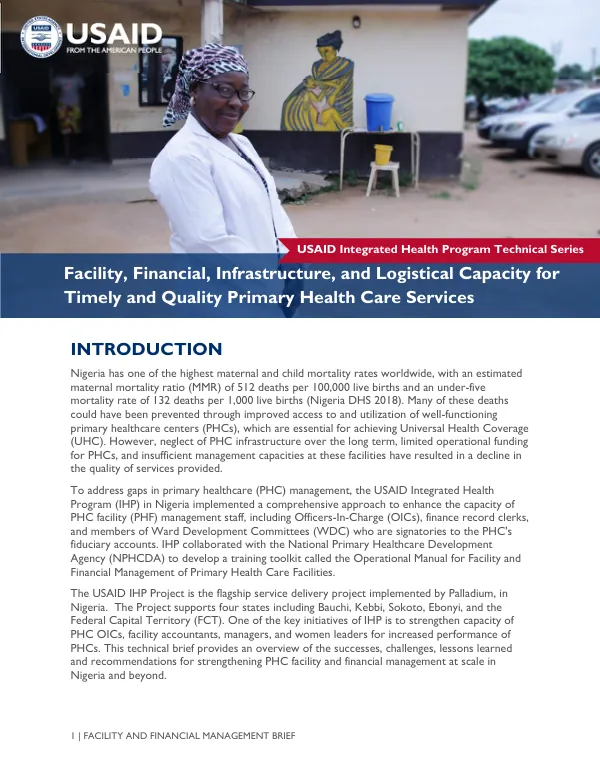
The USAID Integrated Health Program (IHP) in Nigeria implemented a comprehensive approach to enhance the capacity of primary healthcare facility (PHF) management staff.
2024 · 10 pages
Sign in to readA free account is required to download.
Abstract
The program aimed to strengthen the leadership and management capacity of PHC Officers-In-Charge (OICs), Ward Development Committee (WDC) members, and facility accountants for improving efficiency of PHC resource management and effective facility management. The IHP collaborated with the National Primary Healthcare Development Agency (NPHCDA) to develop a training toolkit called the Operational Manual for Facility and Financial Management of Primary Health Care Facilities. The toolkit was designed to equip PHC teams with the requisite skills to effectively fulfill their planning and management tasks, including planning, organizing, controlling, and leading in their facilities. The program engaged with local management organizations to conduct state training of trainers and clustered facility-based trainings. The USAID Global Health Supply Chain (GHSC)/Procurement and Supply Chain Management (PSM) Project was also engaged to review the training materials, particularly the DRF component. Strong partnerships with government, academia, civil society, and the private sector were pivotal for the successful roll-out of these training and to institutionalize the knowledge transfer and materials. Facility and financial management training toolkit manuals were developed, with NPHCDA leading the process of design and development to ensure that the content falls within NPHCDA guidelines and minimum standards for delivery of services at PHCs in Nigeria. National training of trainers for 17 IHP-supported state professionals was conducted to strengthen their capacity for conducting state-level training of trainers. Master trainers were selected in collaboration with the states based on past BHCPF experience and management, finance, personnel, and drugs management. State-level training of trainers was carried out to 157 staff, some of which were experienced staff who had initially been trained as trainers for the roll-out of the BHCPF. Facility-level training via a clustered LGHA/ACHA approach was conducted, with facility managers being trained at the LGHA/Area Council Health Authority level in batches of 30 participants on average. This approach reached 2,915 facility staff (from 1,025 PHCs) across the four states and FCT. Post-training, monthly mentoring visits were conducted at all PHCs for the first three months following the training. A mentoring checklist was used during these visits, focusing on leadership and management, facility maintenance, equipment management, waste management, and record keeping. The mentoring visits aimed to reinforce learning and enhance practical knowledge application among PHC staff. The program resulted in significant strengthening of institutional capacities within the PHC health system. The training and mentoring approach, combining training and on-the-job mentoring for multiple stakeholders at the PHCs, improved the efficiency of PHC resource management and effective facility management. The program also improved the quality of PHC service delivery and client satisfaction, with a focus on building the leadership and management capacity of PHC OICs, WDC members, and facility accountants.
Related documents