USAID DEC
ILRG Malawi Implementation Plan: Integrated Land and Resource Governance Task Order under the Strengthening Tenure and Resource Rights II (STARR II) IDIQ
Sign inGOVERNMENT OF MALAWI
ILRG Malawi Implementation Plan: Integrated Land and Resource Governance Task Order under the Strengthening Tenure and Resource Rights II (STARR II) IDIQ
The Integrated Land and Resource Governance (ILRG) task order aims to provide support to the United States Agency for International Development's (USAID) Land and Resource Governance Team to develop and implement targeted interventions in select countries, including Malawi.
2021 · 27 pages
Sign in to readA free account is required to download.
Abstract
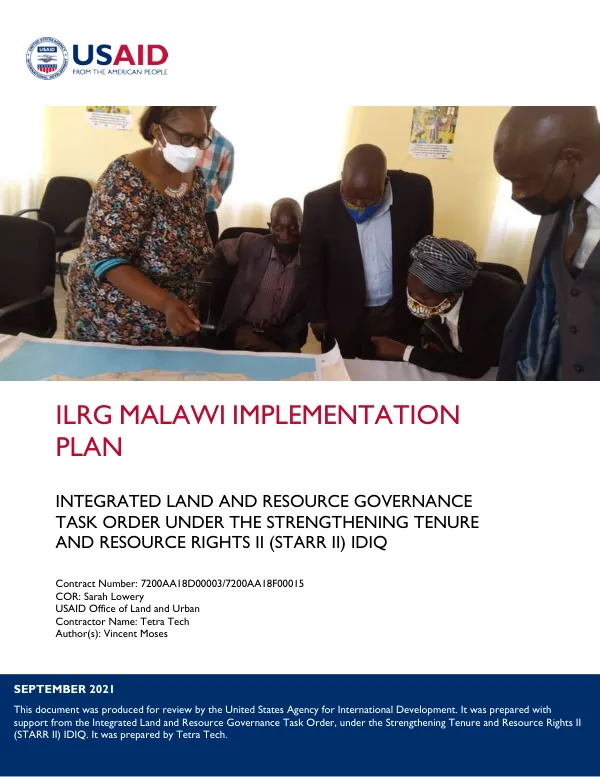
The purpose of the ILRG task order is to remove tenure-related barriers to achieving priority development objectives such as conflict prevention and mitigation, countering violent extremism, and promoting inclusive economic growth. In Malawi, the government enacted a series of land laws in 2016, including the Customary Land Act 2016, which requires all customary landholders to formalize ownership through registration of their parcels. Pilot activities have been conducted in seven districts ahead of a countrywide systematic customary land registration supported by development partners and donors. Formalizing land rights in customary estates through titling is expected to improve security of tenure, but there is a risk of formalizing exclusion of women and other marginalized groups unless the process addresses social and cultural norms and attitudes that undermine women's land rights. ILRG is working to support gender integration in customary land documentation in Malawi, recognizing that while the legal framework for customary land documentation is in place, implementation is in its early stages. The activity will take place over approximately two years and aims to support gender integration across the full customary estate documentation process and administration on a single traditional land management area (TLMA). ILRG proposes to provide technical assistance to a district level land registry and clerks, promote the inclusion of women and youth in the land documentation process, engage key stakeholders to shift gender norms around women's land rights, and convene dialogues with national and international stakeholders to discuss lessons learned and build positive momentum on gender and customary land documentation work. The activity is expected to benefit up to 45,000 people, with the number to be confirmed upon final selection of the group village headpersons (GVHs) to be supported within the TLMA. ILRG will contribute to USAID/Malawi's overarching goal of advancing gender equality and women's empowerment. The proposed activities will be standalone and achieve impact within the two-year timeframe, with no assumption of additional investment in the sector in Malawi. ILRG will provide technical assistance to a district level land registry and clerks to support the development of gender-responsive land guidelines, process manuals, and implementation practical notes. The activity will also engage key stakeholders to shift gender norms around women's land rights at institutional, community, and household levels. Convening dialogues with national and international stakeholders will be an essential component of the activity to discuss lessons learned and build positive momentum on gender and customary land documentation work. The implementation of the ILRG task order in Malawi will focus on three key areas: awareness, outreach, and field implementation materials on scaling gender-responsive customary documentation and land governance processes; support to the Land Reform Implementation Unit (LRIU) for documentation of one Traditional Land Management Area (TLMA); and conducting evidence-based land and women's empowerment-focused dialogues. Monitoring, evaluation, and learning will be essential components of the activity to ensure that the proposed interventions are effective and sustainable. The ILRG task order in Malawi is expected to contribute to the advancement of gender equality and women's empowerment, as well as promote inclusive economic growth and reduce poverty. The activity will also support the development of a more inclusive and equitable land governance system in Malawi, which is essential for achieving the country's development objectives.