CARE
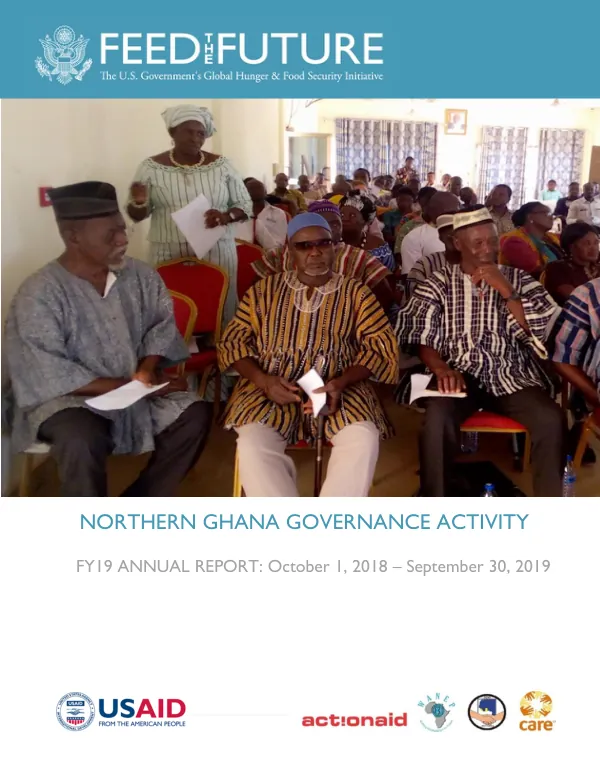
Impact Evaluation Brief: Ghana Strengthening Accountability Mechanisms (GSAM)
The Ghana Strengthening Accountability Mechanisms (GSAM) evaluation aims to determine whether bottom-up or top-down approaches lead to greater accountability and improved service delivery in local government service provision.
2015 · 2 pages
Sign in to readA free account is required to download.
Abstract
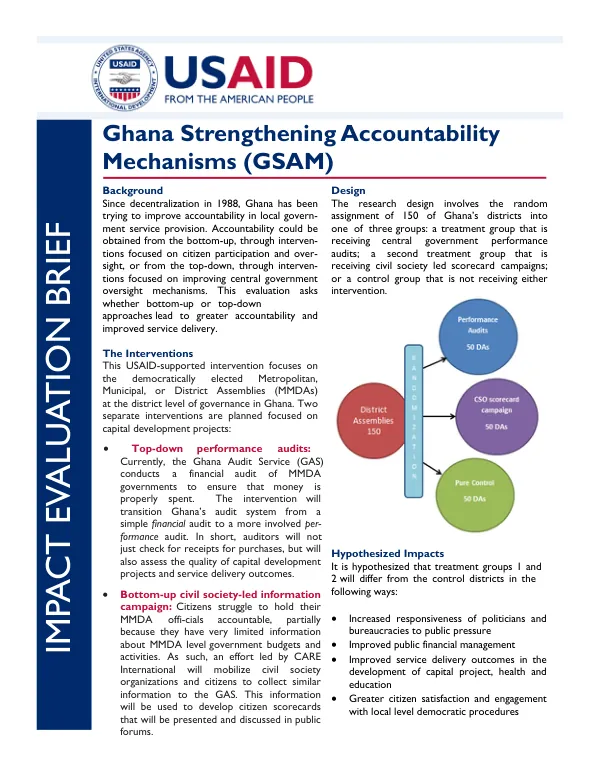
Since decentralization in 1988, Ghana has been trying to improve accountability in local government service provision through interventions focused on citizen participation and oversight, or through improving central government oversight mechanisms. The GSAM intervention focuses on the democratically elected Metropolitan, Municipal, or District Assemblies (MMDAs) at the district level of governance in Ghana. Two separate interventions are planned, focused on capital development projects: top-down performance audits and bottom-up civil society-led information campaigns. The top-down intervention involves transitioning Ghana's audit system from a simple financial audit to a more involved performance audit, assessing the quality of capital development projects and service delivery outcomes. The bottom-up intervention involves mobilizing civil society organizations and citizens to collect information on MMDA level government budgets and activities, developing citizen scorecards to be presented and discussed in public forums. The research design involves the random assignment of 150 of Ghana's districts into one of three groups: a treatment group receiving central government performance audits, a second treatment group receiving civil society-led scorecard campaigns, or a control group not receiving either intervention. It is hypothesized that treatment groups 1 and 2 will differ from the control districts in terms of increased responsiveness of politicians and bureaucracies to public pressure, improved public financial management, improved service delivery outcomes, and greater citizen satisfaction and engagement with local level democratic procedures. Data collection for the evaluation includes household surveys, local elected official and MMDA administrator surveys, focus groups with citizens, and administrative data on district financial management and public service indicators. Baseline data was collected between August and October 2014, revealing a number of areas for improvement. Citizens are dissatisfied with the performance of the District Assembly in delivering and improving on local services, with over 70% dissatisfaction with roads and public sanitation. Corruption is a big problem among public officials, with approximately half of all respondents being 'very or somewhat dissatisfied' with governance by their elected district and national officials. Administrators, on the other hand, are quite optimistic about district governance, reporting that planning of district capital projects is open and participatory, and that public administration is professional and fairly apolitical. However, elected officials recognize some challenges, including the late completion of development projects and corruption in the district public sector. Survey experiments found that household respondents believe that 45% of district budgets for capital projects are wasted, whereas politicians believe that only 15% of funds are misspent or wasted. The experiments also suggest that 26% of household respondents vote on the basis of personal favors delivered by politicians to them or their family, and that 40% of public administrators and nearly 50% of political officials see their colleagues providing members of their ethnic group or political party with privileged access to public resources. Once endline data is collected in late 2016, the evaluation team will be able to test whether the USAID-supported interventions have influenced the above-mentioned factors and whether the top-down or bottom-up interventions were more effective.
Related documents