USAID
Impact Evaluation of Scaling up Early Reading Intervention (SERI)
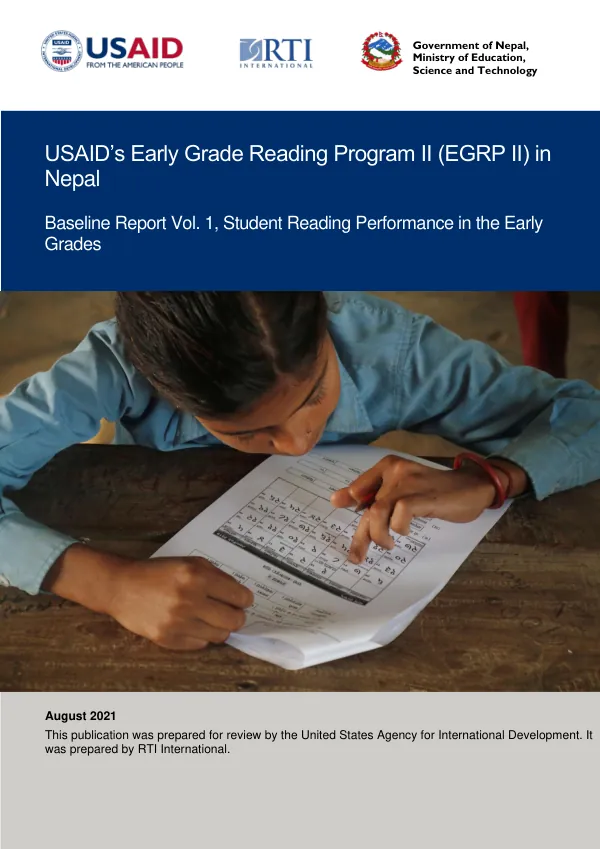
Scaling up Early Reading Intervention (SERI) is a large-scale and innovative early-grade reading program implemented by Room to Read in government primary schools in India.
2018 · 12 pages
Sign in to readA free account is required to download.
Abstract
The program was launched in 2015 with funding from the United States Agency for International Development (USAID) and aimed to develop children's reading skills and reading habits in the early primary grades. The foundation for SERI is Room to Read's Literacy Program, a school-based intervention that seeks to develop children's reading skills and reading habits through instruction and library and quality reading materials. The instruction component provides a strong foundation in reading and writing skills for all early primary grade children, with the goal that children will become fluent readers by the end of Grade 2. The program includes detailed lesson plans, reading materials, and comprehensive teacher professional development training. The first phase of SERI started with Room to Read demonstrating a comprehensive and effective high-fidelity model to improve reading skills of early-grade children through direct implementation of the program in select government primary schools. This model was first launched in 180 schools in Chhattisgarh and Uttarakhand at the beginning of the 2015-16 academic year. Two years later, in 2017-18, the demonstration model was expanded to 90 government schools in Madhya Pradesh and Uttar Pradesh. In the subsequent phase of SERI, Room to Read started providing assistance to the state governments to scale up the model across a larger number of schools. This model was initiated at the beginning of the 2016-17 academic year in 1,010 schools in Chhattisgarh and Uttarakhand. In 2017-18, the partnership model was further expanded to more than 700 schools in Madhya Pradesh and Uttar Pradesh. Alongside the implementation of the SERI under these two models, Room to Read conducted studies to evaluate the impact of the intervention on children's reading skills. The studies used the Early Grade Reading Assessment (EGRA) to measure the most basic foundation skills for literacy acquisition in early grades. The EGRA measured phonological awareness, print knowledge, and orthographic knowledge through different reading subtasks. The impact evaluation results showed that children in SERI schools under the demonstration model experienced greater and statistically significant gains in reading skills than their counterparts in comparison schools. On average, project school children made 1.5 to 2 times greater progress than their comparison-school counterparts on the various reading skills assessed. The effect sizes for SERI under the demonstration model were large (i.e. greater than 0.8) across all four reading skills assessed, with the largest effect size of 1.4 estimated for oral reading fluency. The results also showed that about 32 percent of the children in project schools met or exceeded the oral reading fluency benchmark of 45 correct words per minute by the end of Grade 2, compared to only 8 percent for comparison school children. Also, 35 percent of the project school children reached the 80 percent reading comprehension benchmark, whereas just 13 percent of the comparison school children reached the same benchmark. Independent studies in multiple countries have shown that children at the end of Grade 2 need to reach a fluency rate of roughly 45 to 60 words read correctly per minute as a prerequisite for reading with comprehension. Room to Read aims for children to reach oral reading fluency rates of 45 to 60 words per minute by the end of Grade 2. The prevalence of non-readers is significantly lower in Literacy Program schools under the demonstration model. The SERI program has shown promising results in improving reading skills and reducing the prevalence of non-readers in government primary schools in India. The program's impact evaluation results provide valuable insights into the effectiveness of the intervention and highlight the need for continued support and scaling up of the program to reach more children.
Related documents
Documents in this collection
 2019
2019USAID DEC
Variation Study Midline Report: A Mixed-Methods Experimental Study with Four Treatment Arms to Identify the Cost-Effectiveness of Different Ingredients of a Literacy Intervention for Early Grades: Evidence from the Pakistan Reading Project in KP
Open record 2018
2018USAID DEC