USAID DEC
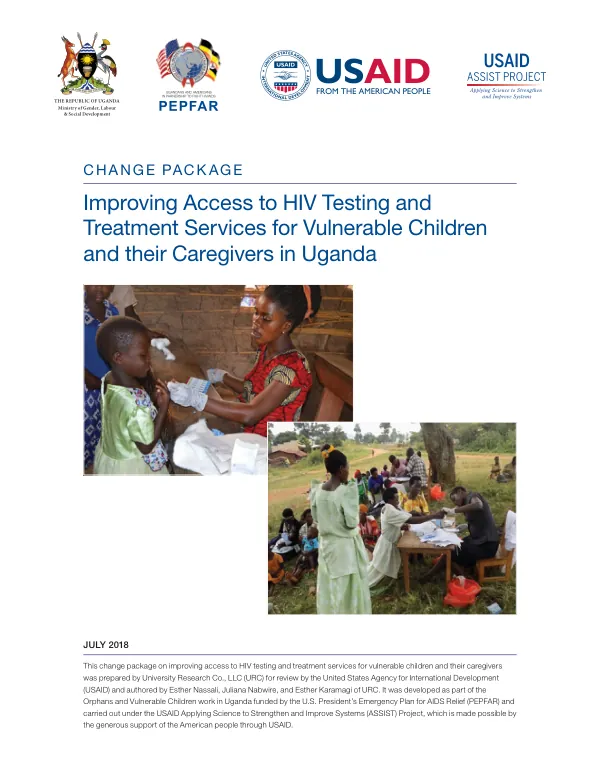
Improving Access to HIV Testing and Treatment Services for Vulnerable Children and their Caregivers in Uganda
Sign inUNIVERSITY RESEARCH CORPORATION CO., LLC
Improving Access to HIV Testing and Treatment Services for Vulnerable Children and their Caregivers in Uganda
Improving Access to HIV Testing and Treatment Services for Vulnerable Children and their Caregivers in Uganda began in 2018 with the goal of addressing the significant impact of the HIV epidemic on children's wellbeing.
2018 · 20 pages
Sign in to readA free account is required to download.
Abstract
The National Household Survey 2010 revealed that 14% of children in Uganda were orphaned, with 45.6% of this orphanhood attributed to HIV/AIDS, and 105,000 children between 0-14 years of age were HIV positive. The HIV epidemic has resulted in a significant gap in access to HIV care and treatment for children compared to adults. The 2016 Uganda HIV Population Based Impact Survey reported that HIV prevalence among children below 15 accounted for 7.4% of HIV-infected persons, with only 73% having a known HIV status, 67% enrolled in HIV care, and 67% virally suppressed. To achieve the UNAIDS epidemic control goals of 90-90-90, efforts are needed to close gaps along the HIV prevention and treatment cascade. The USAID Applying Science to Strengthen and Improve Systems (ASSIST) Project, managed by University Research Co., LLC (URC), implemented the Orphans and Vulnerable Children (OVC) work in Uganda, funded by the U.S. President's Emergency Plan for AIDS Relief (PEPFAR). The project aimed to improve access to HIV testing and treatment services for vulnerable children and their caregivers. The methodology involved Quality Improvement (QI) support mechanisms, including QI training, coaching and mentoring, collaborative learning meetings, and strengthening partnerships with service providers. The QI collaborative aimed to improve the quality of HIV testing and treatment services for vulnerable children and their caregivers. The project implemented several interventions, including the development of a community-based HIV screening tool for children, a Ministry of Gender, Labour and Social Development (MGLSD) referral form for vulnerable children, and a PLHIV home visit form. The project also established a collaborative learning platform for quality improvement teams to share best practices and lessons learned. The results of the project showed a significant improvement in access to HIV testing and treatment services for vulnerable children and their caregivers. The project also identified several lessons learned, including the importance of community engagement and participation in quality improvement initiatives. The project recommended that future initiatives focus on strengthening partnerships with service providers, improving access to HIV testing and treatment services, and enhancing community-based HIV screening and referral systems. The project also emphasized the need for continued support for vulnerable children and their caregivers to achieve the UNAIDS epidemic control goals of 90-90-90.