JHPIEGO
Improving Malaria Care, Burkina Faso
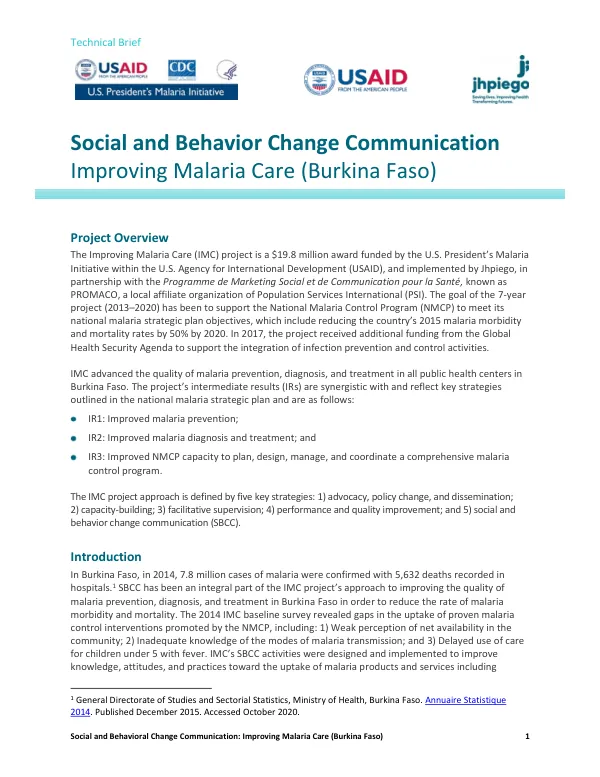
The Improving Malaria Care (IMC) project in Burkina Faso was a seven-year initiative funded by the President's Malaria Initiative within the U.S.
2020 · 4 pages
Sign in to readA free account is required to download.
Abstract
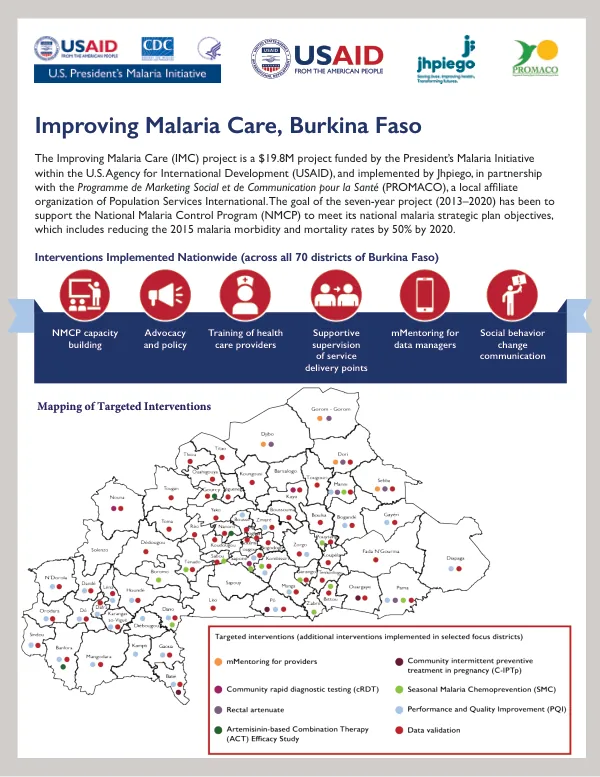
Agency for International Development (USAID). Implemented by Jhpiego in partnership with the Programme de Marketing Social et de Communication pour la Santé (PROMACO), the project aimed to support the National Malaria Control Program (NMCP) in meeting its national malaria strategic plan objectives. The primary goal was to reduce malaria morbidity and mortality rates by 50% by 2020. The project implemented various interventions nationwide, including NMCP capacity building, advocacy and policy support, training of health care providers, supportive supervision of service delivery points, mentoring for data managers, and social behavior change communication. The project also focused on increasing the uptake of intermittent preventive treatment in pregnancy (IPTp), distributing insecticide-treated nets (ITNs) to pregnant women at antenatal care clinics (ANC), and reaching children targeted for seasonal malaria chemoprevention (SMC). The project achieved significant results in enhancing the capacity of NMCP staff, with 78 Ministry of Health (MOH) staff trained on advanced malariology, 65 professors from the national school of nurses and midwifery trained on the malaria health management information system (HMIS), and 40 MOH staff trained in malaria monitoring and evaluation. Additionally, 100% of data managers from districts, regional directorate, and hospital were trained, and 53 of Burkina's 70 health districts were covered with directly supported training sessions in malaria case management. The project also improved national capacity to collect, analyze, and improve malaria data and the information management system. Malaria data was integrated into the national HMIS, and a malaria data quality assessment system was established, resulting in improved malaria data accuracy from 43% in 2014 to 83% in 2017. The project also increased the number of malaria cases treated after confirmation with parasitological tests and reduced presumptive treatment. The project's intermediate results included improved national capabilities, enhanced capacity of NMCP staff, and improved malaria data quality. The project also achieved high-level impact, with an estimated 17,795 deaths averted and 1.4 million disability-adjusted life years (DALYs) averted from 2014 to 2019. The project contributed significantly to the noted reduction in malaria morbidity and mortality in Burkina Faso during its life. The project's social behavior change communication (SBCC) efforts reached 1,218,198 people through community health worker interpersonal communications and 6,148 radio and TV spots aired to promote malaria prevention and treatment. The project also achieved significant reductions in malaria test positivity rate, malaria parasite prevalence in children under-5, and malaria fatality rate in the general population, pregnant women, and children under-5. Overall, the IMC project in Burkina Faso made significant contributions to the reduction of malaria morbidity and mortality in the country, and its results have the potential to inform future malaria control efforts in the region.