JHPIEGO
Improving Malaria Care Quarterly Report 3 /Project Year 3
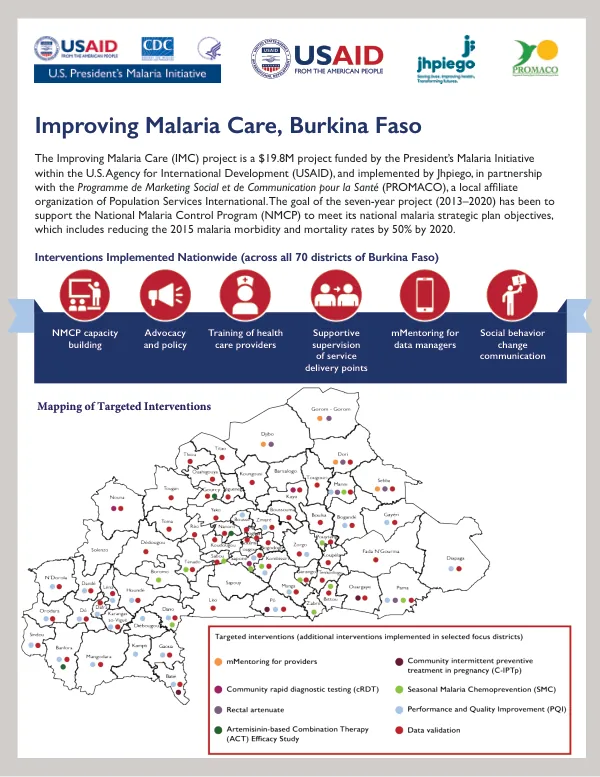
The Improving Malaria Care Project in Burkina Faso was awarded in October 2013, with a five-year duration and funding from the United States Agency for International Development (USAID).
2016 · 45 pages
Sign in to readA free account is required to download.
Abstract
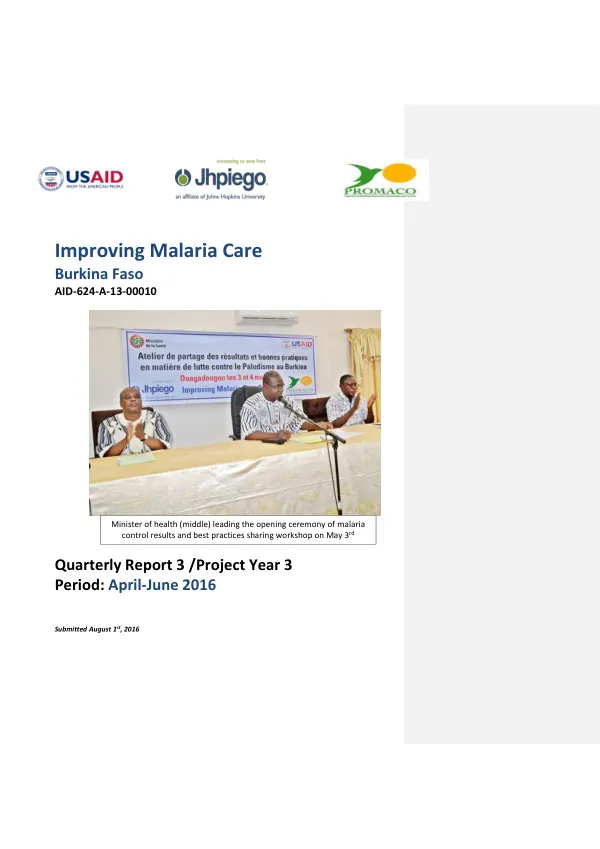
The project is implemented by Jhpiego in collaboration with PROMACO, with the goal of supporting the National Malaria Control Program (NMCP) to strengthen malaria control at health centers and in communities. The project aims to contribute to reducing malaria morbidity and mortality in Burkina Faso by 50% by 2015, in accordance with the national malaria strategic plan. The project's intermediate results are focused on improving malaria prevention, management, and capacity of the NMCP. During the first two and a half years of implementation, the IMC project has achieved several successes, including measurable progress toward achieving its objectives. The project's quarterly report for the third quarter of the third project year, covering April 1 to June 30, 2016, highlights the activities completed during this period. Training of 475 health providers on the prevention and management of malaria was completed, with 215 female providers trained. Orientation of 113 health managers on the utilization of data for decision-making was also completed, with 17 female managers oriented. A workshop was organized to share results and best practices regarding malaria control, and revised tools for malaria-specific supervision were developed. Additionally, 105 health providers were trained on module 3 of the SBM-R approach, which focuses on institutionalizing the process and identifying methods for rewards. The project also continued communication behavior change activities to support malaria control and participated in technical committees of the community health steering committee. Furthermore, IMC project staff met with newly appointed directors in the Ministry of Health to inform them about the project, its objectives, implementation challenges, and request their engagement in the project. In the next quarter, the project will focus on strengthening the capacity of health workers at referral facilities, continuing advocacy to update IPTp guidelines, implementing the SBM-R process, conducting communications/health promotion activities, carrying out the audit of malaria data quality, and preparing the IMC year 4 work plan. The project's strategy 1, advocacy, policy change, and dissemination, involved technical committee meetings under the National Malaria Steering Committee. Two technical committees met this quarter, focusing on monitoring, evaluation, and research, and the epidemiological situation of malaria from 2011-2015. Recommendations were proposed to the NMCP, including strengthening understanding of the epidemiological situation of malaria and evaluating the effectiveness of Seasonal Malaria Chemoprevention (SMC) in Burkina Faso. Strategy 2, capacity building, involved training of 475 health providers on the prevention and management of malaria, with 215 female providers trained. Orientation of 113 health managers on the utilization of data for decision-making was also completed, with 17 female managers oriented. Strategy 3, supportive supervision, involved revising tools for malaria-specific supervision and training 105 health providers on module 3 of the SBM-R approach. Strategy 4, performance and quality improvement, involved continuing communication behavior change activities to support malaria control and participating in technical committees of the community health steering committee. Strategy 5, behavior change communication, involved continuing to implement the SBM-R process and conducting communications/health promotion activities. The project's key achievements in the third quarter of the third project year include training of 475 health providers, orientation of 113 health managers, and completion of a workshop to share results and best practices regarding malaria control. The project also continued communication behavior change activities and participated in technical committees of the community health steering committee.