JHPIEGO
Social and Behavioral Change Communication: Improving Malaria Care (Burkina Faso)
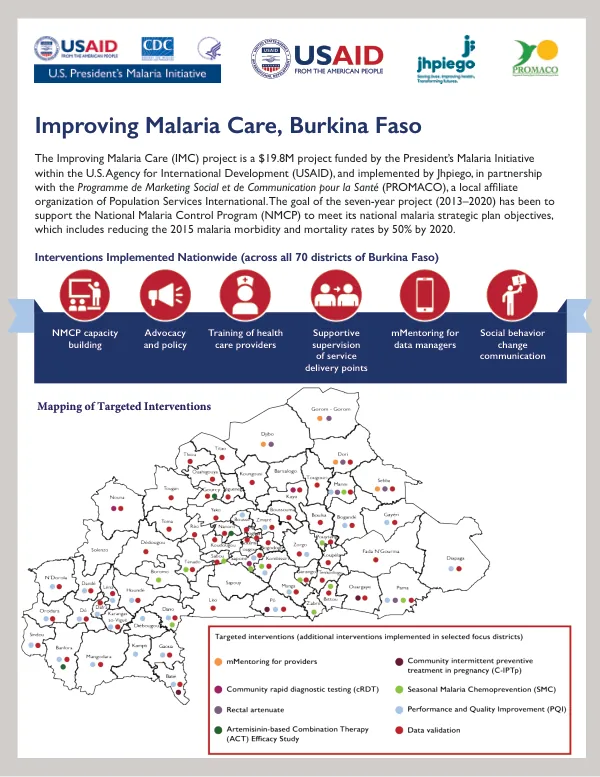
The Improving Malaria Care (IMC) project in Burkina Faso aimed to support the National Malaria Control Program (NMCP) in reducing the country's malaria morbidity and mortality rates by 50% by 2020.
2020 · 5 pages
Sign in to readA free account is required to download.
Abstract
The project, funded by the U.S. President's Malaria Initiative and implemented by Jhpiego in partnership with PROMACO, a local affiliate organization of Population Services International, was a $19.8 million award that spanned 7 years (2013-2020). In 2017, the project received additional funding from the Global Health Security Agenda to support the integration of infection prevention and control activities. The IMC project's intermediate results (IRs) were synergistic with and reflected key strategies outlined in the national malaria strategic plan. The IRs included improved malaria prevention, improved malaria diagnosis and treatment, and improved NMCP capacity to plan, design, manage, and coordinate a comprehensive malaria control program. The project's approach was defined by five key strategies: advocacy, policy change, and dissemination; capacity-building; facilitative supervision; performance and quality improvement; and social and behavior change communication (SBCC). In Burkina Faso, in 2014, 7.8 million cases of malaria were confirmed with 5,632 deaths recorded in hospitals. SBCC has been an integral part of the IMC project's approach to improving the quality of malaria prevention, diagnosis, and treatment in Burkina Faso. The 2014 IMC baseline survey revealed gaps in the uptake of proven malaria control interventions promoted by the NMCP, including weak perception of net availability in the community, inadequate knowledge of the modes of malaria transmission, and delayed use of care for children under 5 with fever. The IMC project used SBCC to increase demand for malaria prevention and case management services through communication. This included mass media broadcasts, group events and contests, and interpersonal communication. The project aimed to increase the proportion of children under age 5 and pregnant women who slept under an ITN every night, the proportion of children 5 with fever who sought treatment from a facility/provider on the same or next day, and the proportion of women aged 15-19 who heard a malaria message. At the national level, IMC provided technical and financial support to the NMCP to organize a workshop to develop and finalize the integrated communication plan to go with the 2016-2020 national malaria control strategic plan. The project worked with the Ministry of Health (MOH) to strengthen capacity to use SBCC messages in an effective and culturally appropriate way to increase demand for services and antimalarial products through the revision and adoption of 14 communication tools according to recommendations from the World Health Organization. Mass communication played a significant role in the IMC project, with 3,431 spots on ITN use and IPTp broadcasted on public and private networks in nine regions across the country from 2014 to 2019. IMC supported the NMCP to create 16 billboards for sensitization on ITN use in the health centers where community health workers (CHWs) gather monthly for communication activities. The IMC project also conducted regional advocacy workshops to strengthen the engagement and commitment of administrative, religious, and traditional and civil society leaders in malaria control. The regional workshops, each chaired by the region's governor, took place in nine of the country's 13 regions, which included the 21 districts. These workshops enabled leaders to confirm their commitment to support malaria control. Community mobilization via caravans and campaigns was another key strategy employed by the IMC project. IMC organized an antimalaria caravan with artists in four health districts (Koudougou, Réo, Ténado, and Sabou) in the Centre-Ouest region. During the campaign, advocacy activities were carried out with the political, administrative, and customary and religious authorities of the districts to obtain support for the fight against malaria. The IMC project also used the PSI's PerForM conceptual framework to study opportunity, capacity, and motivation scores as determinants of behavior change and used to inform the planning of SBCC activities. Opportunity refers to the external or environmental factors that contribute to the availability of the desired behavior. Capacity is the necessary skills and knowledge to perform the desired action. Motivation involves both the desire and decision-making process required for the individual to choose the behavior. The IMC project sponsored a campaign, called "Children mobilizing against malaria," to support malaria sensitization at the community level. The campaign aimed to increase awareness and knowledge about malaria prevention and treatment among children and their families. The campaign included public events, video screenings, and discussions, and reached a total of 6,030 people. The IMC project's SBCC activities were designed to improve knowledge, attitudes, and practices toward the uptake of malaria products and services, including insecticide-treated nets (ITNs), intermittent preventive treatment in pregnancy (IPTp), diagnosis, and treatment. The project's SBCC interventions aimed to increase the proportion of children under