USAID DEC
Improving the survival of at-risk infants through pediatric development clinics in Rwanda
Sign inINTRAHEALTH
Improving the survival of at-risk infants through pediatric development clinics in Rwanda
The USAID Ingobyi Activity initiated Pediatric Development Clinics (PDCs) in selected health facilities in Musanze and Rutsiro districts, Rwanda, to provide holistic care to at-risk infants.
2021 · 1 pages
Sign in to readA free account is required to download.
Abstract
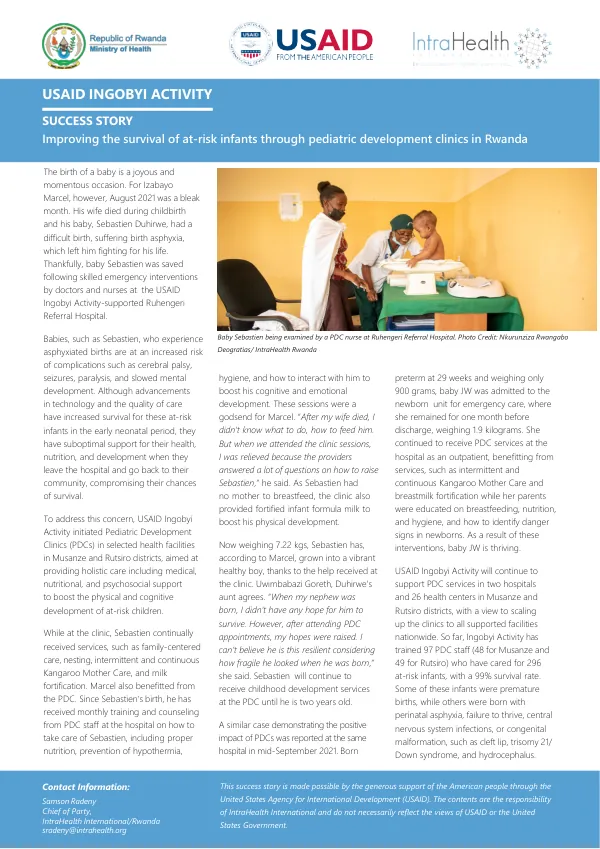
The clinics aimed to boost the physical and cognitive development of children who experienced birth asphyxia, preterm birth, or other complications. PDCs offered medical, nutritional, and psychosocial support, including family-centered care, nesting, intermittent and continuous Kangaroo Mother Care, and milk fortification. At the Ruhengeri Referral Hospital, a baby named Sebastien Duhirwe was born in August 2021 with birth asphyxia. He was saved following skilled emergency interventions by doctors and nurses. Sebastien received services at the PDC, including family-centered care, nesting, and milk fortification. His father, Marcel, also received training and counseling on how to care for Sebastien, including proper nutrition, prevention of hypothermia, hygiene, and how to interact with him to boost his cognitive and emotional development. As a result, Sebastien has grown into a vibrant and healthy boy, weighing 7.22 kilograms. Another case demonstrating the positive impact of PDCs was reported at the same hospital in mid-September 2021. Baby JW was born preterm at 29 weeks and weighing only 900 grams. She received PDC services, including intermittent and continuous Kangaroo Mother Care and breastmilk fortification, while her parents were educated on breastfeeding, nutrition, and hygiene. As a result of these interventions, baby JW is thriving. The USAID Ingobyi Activity has trained 97 PDC staff, who have cared for 296 at-risk infants with a 99% survival rate. Some of these infants were premature births, while others were born with perinatal asphyxia, failure to thrive, central nervous system infections, or congenital malformation. The activity will continue to support PDC services in two hospitals and 26 health centers in Musanze and Rutsiro districts, with a view to scaling up the clinics to all supported facilities nationwide. The success of PDCs has been attributed to the training and support provided to PDC staff, who have been able to care for at-risk infants and provide them with the necessary support to thrive. The activity's focus on providing holistic care to at-risk infants has resulted in improved survival rates and better health outcomes for these children.