PATH
Improving urban sanitation in Benin
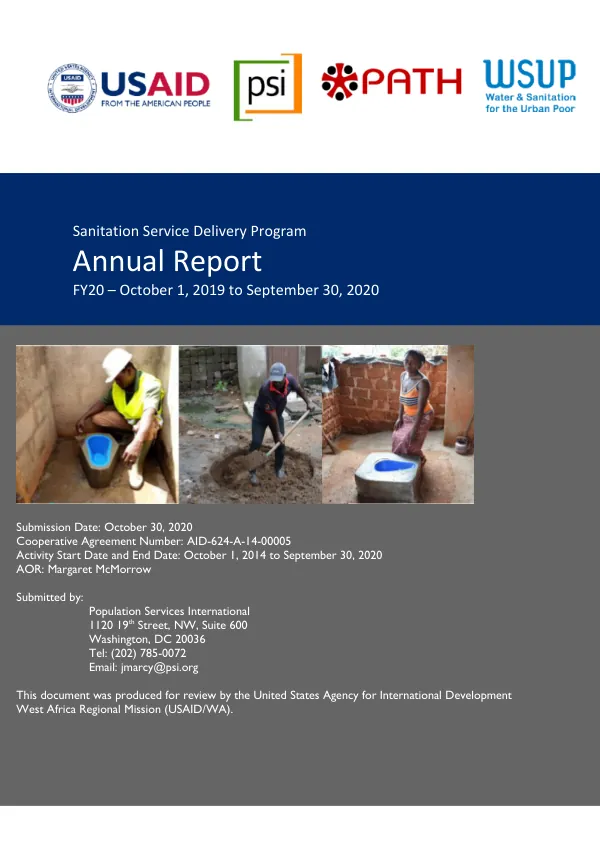
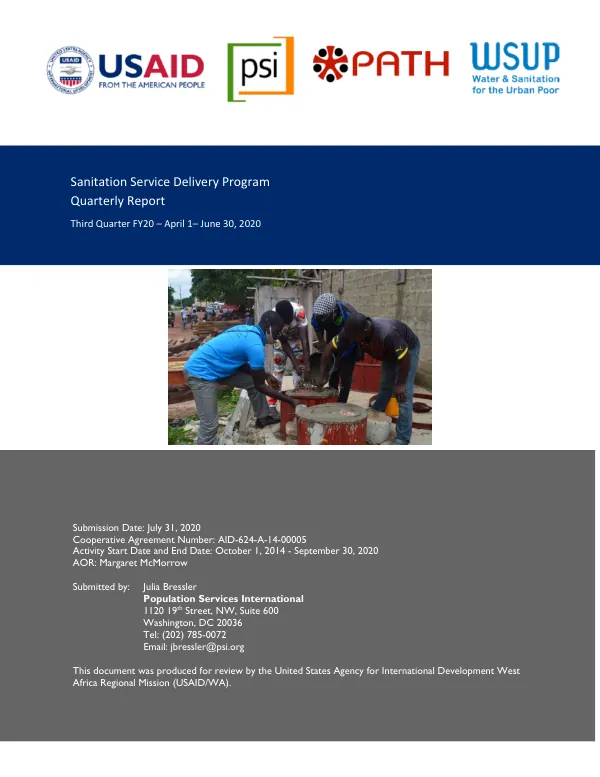
The Sanitation Service Delivery (SSD) program is a United States Agency for International Development (USAID)/West Africa urban sanitation project being implemented in Benin, Côte d'Ivoire, and Ghana by Population Services International (PSI) in collaboration with PATH and Water and Sanitation for the Urban Poor (WSUP).
2016 · 4 pages
Sign in to readA free account is required to download.
Abstract
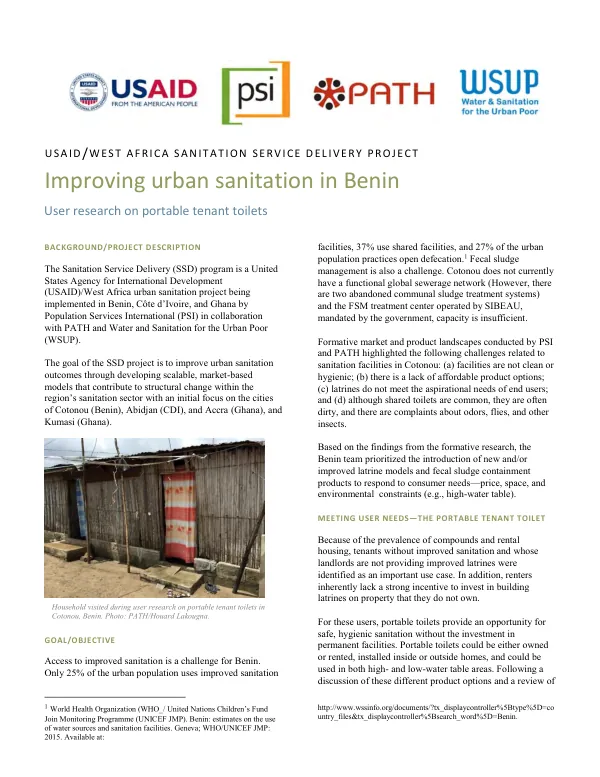
The goal of the SSD project is to improve urban sanitation outcomes through developing scalable, market-based models that contribute to structural change within the region's sanitation sector, with an initial focus on the cities of Cotonou (Benin), Abidjan (Côte d'Ivoire), and Accra (Ghana), and Kumasi (Ghana). Access to improved sanitation is a challenge for Benin, with only 25% of the urban population using improved sanitation facilities, 37% using shared facilities, and 27% practicing open defecation. Fecal sludge management is also a challenge, with Cotonou lacking a functional global sewerage network and the existing fecal sludge treatment center operated by SIBEAU having insufficient capacity. Formative market and product landscapes conducted by PSI and PATH highlighted the following challenges related to sanitation facilities in Cotonou: facilities are not clean or hygienic, there is a lack of affordable product options, latrines do not meet the aspirational needs of end users, and shared toilets are common but often dirty and plagued by odors, flies, and other insects. To address these challenges, the Benin team prioritized the introduction of new and/or improved latrine models and fecal sludge containment products to respond to consumer needs, including price, space, and environmental constraints. One potential solution is the portable toilet, which provides a safe and hygienic sanitation option without the need for permanent facilities. Portable toilets can be owned or rented, installed inside or outside homes, and used in both high- and low-water table areas. Following a discussion of different product options and a review of technology options, container-based sanitation (CBS) systems, which provide both improved sanitation and proper fecal sludge management, were identified as a technology of interest for an initial round of user research. In April and May 2016, PATH, in collaboration with the local SSD team, designed and implemented user research on a toilet plus service model (CBS) solution for Benin. The objectives of the user research included technical, environmental, and market-related components, such as obtaining user feedback on the acceptability of the toilet and service model, better understanding potential user needs and their environment, and understanding landlord perspectives and potential barriers to portable toilets. The user research involved qualitative interviews with tenants and landlords in four communes in Cotonou, and the findings suggested that a CBS toilet plus service model would be acceptable among end users in Cotonou.
Related documents