USAID DEC
Sanitation Service Delivery Project (SSD) in Benin: Ensuring Quality of Sanitation Products During Project Scale-up
Sign inPOPULATION SERVICES INTERNATIONAL/DKT INTERNATIONAL
Sanitation Service Delivery Project (SSD) in Benin: Ensuring Quality of Sanitation Products During Project Scale-up
The agricultural development initiative in Benin began in 2019 with funding from USAID's Sanitation Service Delivery Project.
2019 · 5 pages
Sign in to readA free account is required to download.
Abstract
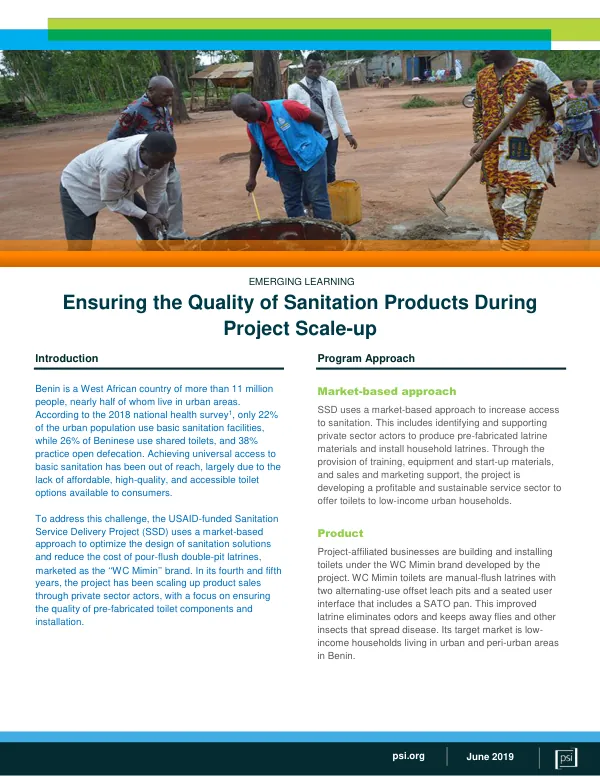
The project aims to address the lack of affordable, high-quality, and accessible sanitation options available to consumers in urban areas. According to the 2018 national health survey, only 22% of the urban population use basic sanitation facilities, while 38% practice open defecation. The project uses a market-based approach to increase access to sanitation by identifying and supporting private sector actors to produce pre-fabricated latrine materials and install household latrines. The project has developed a product called WC Mimin, a manual-flush latrine with two alternating-use offset leach pits and a seated user interface that includes a SATO pan. This improved latrine eliminates odors and keeps away flies and other insects that spread disease. The project team has implemented several interventions to ensure the quality of WC Mimin toilets. Initially, the team provided three days of training and on-site supervision during the first five toilet installations. However, this approach proved to be insufficient, with over 20% of the first 100 latrines installed having problems with the quality of the pre-fabricated components or the installation. To address these issues, the project team established a quality oversight team composed of the project's sanitation engineer, government hygiene and sanitation officers, high-performance masons, and a municipal sanitation officer. The team oversees quality before, during, and after toilet installation, ensuring that pre-fabricated components meet strength and resistance standards, and that latrines are installed correctly. The project has also standardized all molds for prefabricated toilet components, provided a comprehensive starter kit to microentrepreneurs, and established a quality control protocol and reference guide for all project staff and partners. Additionally, the project offers continuous learning opportunities for affiliated entrepreneurs/masons, including provision of technical guidelines and refresher trainings. The project has seen significant improvements in quality control, with the number of problems with pre-fabricated components and installation decreasing over time. The project has also implemented a quarterly customer satisfaction survey to ensure customer satisfaction with the final product and service. Upon completion of the project, capacity building and quality control will be managed by the municipal governments, and project-affiliated microentrepreneurs will organize themselves into associations to receive support from the municipality for the sustainable supply of sanitation products and quality controls. The project has worked collaboratively with government stakeholders, municipalities, waste operators, and project partners to develop a sustainability plan to ensure the long-term success of the project.
Related documents