HELLEN KELLER INTERNATIONAL
Prevention and Management of Acute Malnutrition in Cameroon’s Far-North Region
In Cameroon's Far-North Region, the prevention and management of acute malnutrition is a critical concern.
2020 · 12 pages
Sign in to readA free account is required to download.
Abstract
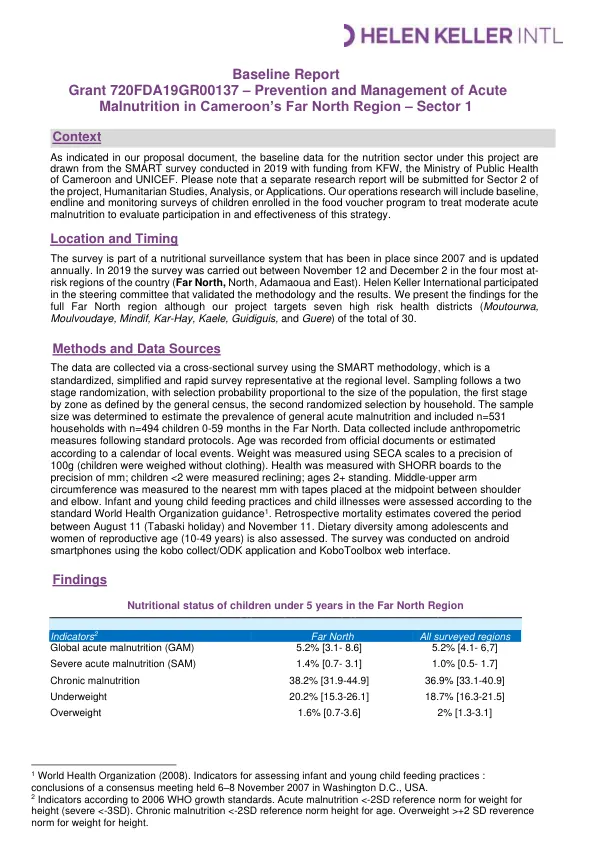
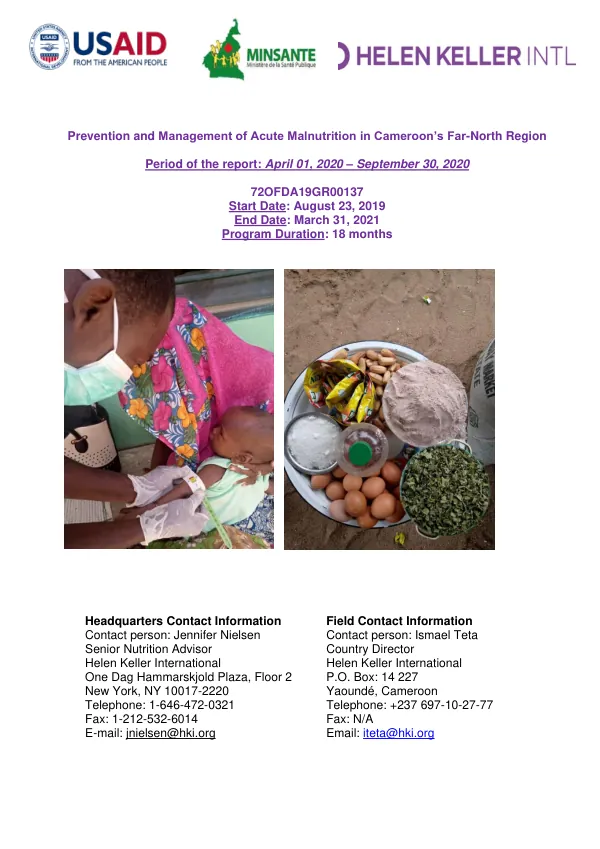
The region has been affected by conflict, placing a burden on fragile health services and livelihoods. According to the 2018 SMART survey, global acute malnutrition in the Far-North Region remains alarming at 9.7%. The Office of United States Foreign Disaster Assistance (OFDA) has supported Helen Keller's nutrition response in the most affected health districts of the region. The project aims to promote preventive actions to reduce the burden of malnutrition and increase the proportion of acutely malnourished children, pregnant, and lactating women receiving treatment in seven health districts of the Far-North Region. The project works at district, facility, and community levels to improve both the prevention and management of acute malnutrition. Existing community platforms are used to deliver monthly community-based screening using middle-upper arm circumference (MUAC) measures to identify and refer children with acute malnutrition for treatment. Implementation of the project has focused on several key interventions. In the management of moderate acute malnutrition (MAM), the project has established 50 sites for outpatient care, trained 891 healthcare providers and volunteers, and treated over 5,700 children. The recovery rate among children treated for MAM has been above 75%, with a default rate below 15%. The project has also strengthened formative supervision systems, with 319 supervision visits to community structures and 11 joint formative supervision visits by district health teams and HKI staff. In addition to MAM management, the project has also focused on infant and young child feeding in emergencies. The project has provided behavior change interventions to improve infant and young child feeding practices, with over 80,000 people receiving interventions. The project has also conducted cooking demonstrations, with over 590 demonstrations organized and over 30,000 participants. The project's implementation research study has documented the delivery of the food voucher program and its effectiveness in improving diets and contributing to the recovery of children 6-59 months.
Related documents