USAID DEC
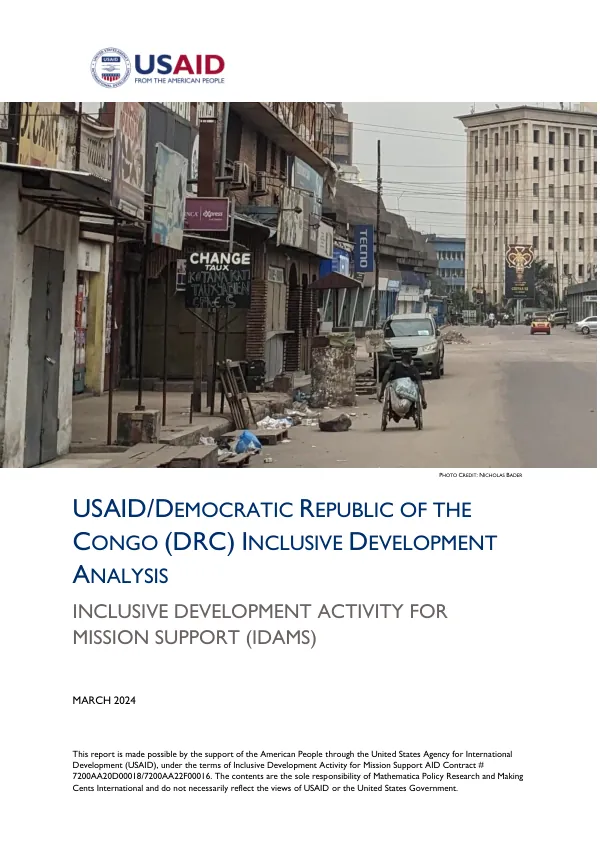
Inclusive Development Activity for Mission Support (IDAMS) Task Order: Inclusive Development Analysis for USAID/DRC
Sign inMAKING CENTS INTERNATIONAL
Inclusive Development Activity for Mission Support (IDAMS) Task Order: Inclusive Development Analysis for USAID/DRC
The Inclusive Development Activity for Mission Support (IDAMS) task order engages diverse perspectives to help expand awareness of power dynamics, foster inclusive mindsets, and embed practices that combat stigma and discrimination, promoting empowerment and improving the lives of those who have been traditionally marginalized in the United States Agency for International Development (USAID) partner countries.
2024 · 6 pages
Sign in to readA free account is required to download.
Abstract
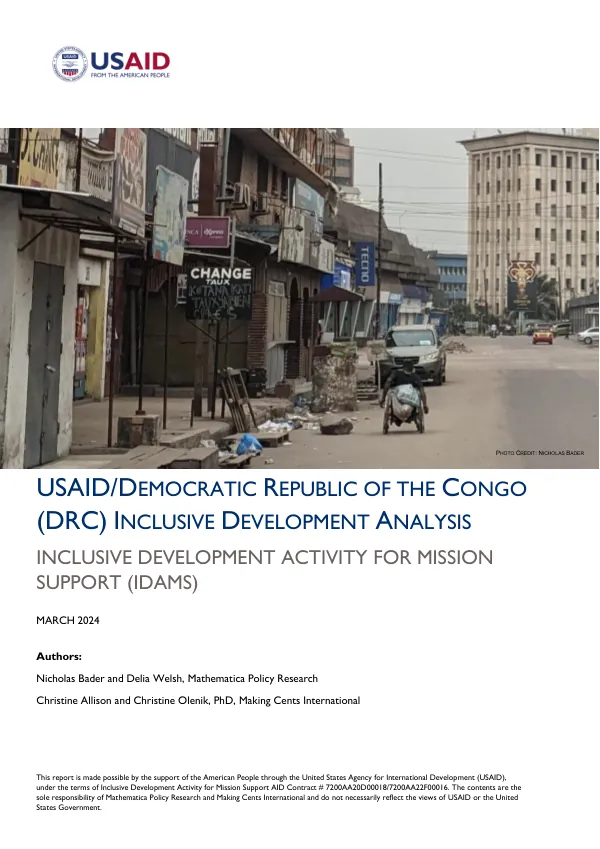
The IDAMS team conducted an inclusive development analysis (IDA) to support USAID's Mission to the Democratic Republic of Congo (USAID/DRC) in its efforts to engage one of the world's most diverse populations across its portfolio of integrated development programming. The IDA included two phases: a design phase that focused on documenting current approaches to inclusive development across USAID/DRC's activities and framing an ID learning agenda, and a second phase that entailed mixed-methods data collection and analysis to answer research questions identified in partnership with USAID/DRC. The IDA took place in urban and peri-urban areas across six provinces of the DRC, including Kinshasa, Kasai Oriental, Tshopo, Haut-Uélé, Mai-Ndombe, and Haut-Katanga. The IDAMS team conducted 73 key informant interviews and 22 focus group discussions with women, youth, Indigenous Pygmy People, and other traditionally marginalized subgroups of these populations identified during the design phase. A community survey (n=1,446) of men, women, youth, and non-youth across the six provinces was also implemented to capture community perspectives on issues pertaining to ID. The main findings of the IDA are presented in three parts: perceived barriers to inclusion, organizational experiences with ID, and opportunities and engagement strategies to advance inclusion through USAID programming. Patterns of power and decision-making, cultural norms and beliefs, access to and control over resources, personal safety and security, and laws, policies, regulations, and institutional practices are identified as key barriers to inclusion in civic, political, and economic spheres. Congolese civil society organizations (CSOs) face challenges in improving the well-being of traditionally marginalized groups, including internal capacity to obtain funding and manage donor resources. Many CSOs remain unaware of platforms that opportunities circulate on, and complex administrative processes and compliance requirements inhibit local partners that lack grant management capacity or experienced staff to navigate USAID's processes. The IDA highlights the socioeconomic vulnerability of Indigenous women relative to Indigenous men and non-Indigenous women, as well as insufficient social and legal services for survivors of gender-based violence outside of the more developed metropolitan areas. Women outside of Kinshasa have limited control over household financial resources due to traditional gender norms, which perpetuate economic disempowerment. The IDA also identifies the need for more equitable partnership practices, including calls for more transparent and inclusive funding opportunities, and greater support for local organizations to build their capacity and manage donor resources effectively. The report presents key findings and recommendations resulting from the IDA, which aim to support USAID/DRC in its efforts to engage one of the world's most diverse populations across its portfolio of integrated development programming.