USAID DEC
Income generation and peace processes: Perspectives on economic reintegration of ex-combatants in Colombia
Sign inFUNDACIÓN IDEAS PARA LA PAZ
Income generation and peace processes: Perspectives on economic reintegration of ex-combatants in Colombia
Income generation and peace processes: Perspectives on economic reintegration of ex-combatants in Colombia.
2016 · 2 pages
Sign in to readA free account is required to download.
Abstract
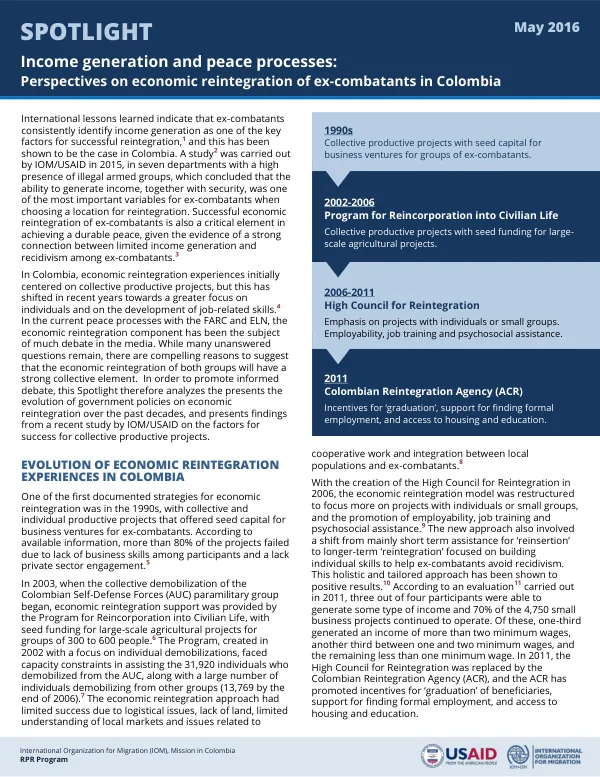
The economic reintegration of ex-combatants is a critical element in achieving a durable peace, given the evidence of a strong connection between limited income generation and recidivism among ex-combatants. In Colombia, economic reintegration experiences initially centered on collective productive projects, but this has shifted in recent years towards a greater focus on individuals and on the development of job-related skills. The evolution of government policies on economic reintegration in Colombia has been marked by a shift from collective productive projects to more individualized approaches. In the 1990s, collective productive projects with seed capital for business ventures for groups of ex-combatants were implemented, but more than 80% of these projects failed due to lack of business skills among participants and a lack of private sector engagement. In 2003, the Program for Reincorporation into Civilian Life provided seed funding for large-scale agricultural projects for groups of 300 to 600 people, but this approach also faced capacity constraints and logistical issues. In 2006, the High Council for Reintegration was established, and the economic reintegration model was restructured to focus more on projects with individuals or small groups, and the promotion of employability, job training, and psychosocial assistance. This approach has been shown to have positive results, with three out of four participants able to generate some type of income and 70% of the 4,750 small business projects continuing to operate. The Colombian Reintegration Agency (ACR) has since promoted incentives for 'graduation' of beneficiaries, support for finding formal employment, and access to housing and education. The current peace processes with the FARC and ELN are likely to call for more collective approaches to economic reintegration. An exploratory study carried out in 2015 by IOM examined capacities for generating sufficient income, relations between costs and benefits, and the sustainability of 57 collective productive projects in Colombia, which included ex-combatants as well as others not involved in reintegration processes. The study concluded that the most successful collective projects had a number of characteristics in common, including strong initial motivation, participative development of the business plan, participation in productive activities, quality of basic services, and roads. The study organized the factors that appeared to have the greatest impact on the global success of each project into four categories: effective participation, external conditions and infrastructure, management and leadership, and social and community factors. While these findings are important, more studies are still needed to deepen our understanding of factors for success or failure of collective approaches to economic reintegration. As peace processes with the FARC and ELN continue to evolve, approaches for economic reintegration will be needed that can take into account and learn from recent experiences in Colombia and international best practice, while adapting to the context and the particular characteristics of each armed group and the peace agreements they reach.
Related documents