USAID DEC
Influence of Conservation Agriculture on Durum Wheat Grain, Dough Texture Profile and Pasta Quality in a Mediterranean Region
Sign inUNITED NATIONS
Influence of Conservation Agriculture on Durum Wheat Grain, Dough Texture Profile and Pasta Quality in a Mediterranean Region
The agricultural development initiative in Tunisia began with a focus on conservation agriculture (CA) to address soil degradation and climate change issues.
2023 · 16 pages
Sign in to readA free account is required to download.
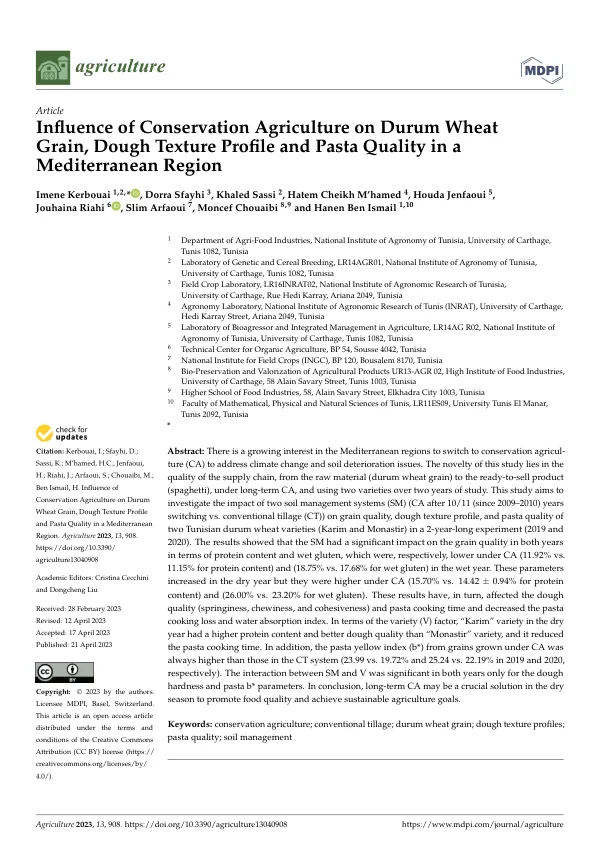
Abstract
CA emerged as an important technique to replace the tillage system, defined by a set of soil management practices composed of no-till, crop rotation diversity, and permanent soil cover. The FAO considered CA as the ideal solution to achieve sustainable agriculture goals by meeting the global demand for future generations while protecting the soil and the environment. Tunisia, like other Mediterranean countries, was experiencing soil degradation due to climate change and intensive tillage. To face these challenges, Tunisian projects began to implement no-till/direct seeding from 1970 to 1980, followed later by the implementation of all CA principles. Many review papers have examined the advantages of CA on crop yields, agro-ecological resources, economic inputs, and soil quality. Several studies have highlighted the benefits of switching to CA on the physical, chemical, and microbiological quality of soil. Durum wheat is an important crop worldwide, and its quality is affected by various factors, including genotypic factor, climatic conditions, soil properties, agronomic practices, and post-harvest grain storage processes. The popularity of pasta is related to its good nutritional, technological, and sensory properties, as well as its low cost. Protein, gluten, and starch are recognized for their strong influences on dough texture profile and pasta cooking quality. Recently, interest in crop quality in CA has increased because of the changes that occur in the soil after switching to CA. A long-term experimental trial was carried out at the National Institute of Field Crops (INGC) in Boussalem, Tunisia, to investigate the effect of long-term CA vs. conventional tillage (CT) on two Tunisian durum wheat varieties (Karim and Monastir) on grain quality, dough texture profile, and pasta quality. The study aimed to examine the effect of the interaction between the soil management factor and the variety factor on quality parameters and to understand the data matrix between quality parameters and individuals using Biplot-PCA. The results showed that the soil management system had a significant impact on grain quality in both years, with protein content and wet gluten being lower under CA in the wet year. However, these parameters increased in the dry year but were higher under CA. The results also affected the dough quality and pasta cooking time, with decreased pasta cooking loss and water absorption index. In terms of the variety factor, the "Karim" variety in the dry year had a higher protein content and better dough quality than the "Monastir" variety, and it reduced the pasta cooking time. The interaction between the soil management and variety factors was significant in both years only for the dough hardness and pasta b* parameters. In conclusion, long-term CA may be a crucial solution in the dry season to promote food quality and achieve sustainable agriculture goals.