AVENIR HEALTH
Infographie des flux de fonds publics consacrés à la santé
The Health Policy Plus (HP+) initiative in Mali is a 7-year cooperative agreement funded by the United States Agency for International Development (USAID) under agreement number AID-OAA-A-15-00051, effective August 28, 2015.
2022 · 3 pages
Sign in to readA free account is required to download.
Abstract
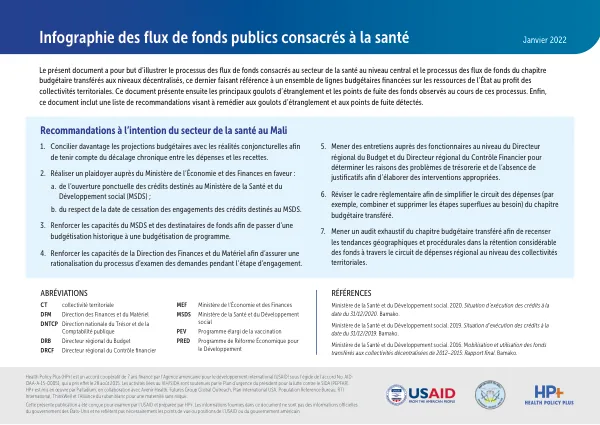
The activities related to HIV/AIDS are supported by the President's Emergency Plan for AIDS Relief (PEPFAR). HP+ is implemented by Palladium in collaboration with Avenir Health, Futures Group Global Outreach, Plan International USA, Population Reference Bureau, RTI International, ThinkWell, and the White Ribbon Alliance for Safe Motherhood. The present publication was designed for review by USAID and prepared by HP+. The information provided in this document is not official information of the United States government and does not necessarily reflect the views or positions of USAID or the U.S. government. The document aims to illustrate the process of public funds flows dedicated to health at the central level and the process of public funds flows of the transferred budget chapter at the decentralized level. The process of public funds flows in Mali involves several stages, including engagement, liquidation, and ordonnancement. Engagement refers to the process of allocating funds to specific projects or activities, while liquidation involves the verification of expenses and the payment of funds to the relevant parties. Ordonnancement refers to the process of issuing payment orders and transferring funds to the intended recipients. The document highlights several challenges and bottlenecks in the process of public funds flows in Mali, including the delay in opening investment credits, the rapid closure of the period during which ministries can engage funds, and the lack of transparency in the process. These challenges result in a low rate of liquidation and a high risk of funds being retained at the regional level. To address these challenges, the document recommends several actions, including conducting interviews with officials at the regional level to determine the reasons for the problems of treasury and the absence of justifications, revising the regulatory framework to simplify the process of expenditure, and conducting an exhaustive audit of the transferred budget chapter to identify trends and procedures in the retention of funds at the regional level. The document also includes an infographic illustrating the process of public funds flows in Mali, which highlights the various stages involved in the process, including the vote of the finance law, engagement, liquidation, and ordonnancement. The infographic provides a visual representation of the complex process of public funds flows in Mali and highlights the need for greater transparency and efficiency in the process. In terms of geographic focus and context, the document is focused on the health sector in Mali, with a particular emphasis on the challenges and bottlenecks in the process of public funds flows. The document is relevant to policymakers and stakeholders in the health sector in Mali, as well as to international development organizations and donors who are working to support the health sector in Mali. In terms of timeframes and recommendations, the document provides a detailed analysis of the challenges and bottlenecks in the process of public funds flows in Mali, as well as several recommendations for addressing these challenges. The document is relevant to policymakers and stakeholders in the health sector in Mali, as well as to international development organizations and donors who are working to support the health sector in Mali.
Related documents